An isolated rail car originally moving with speed $v_0$ on a straight, frictionles, level track contains a large amount of sand. $A$ release valve on the bottom of the car malfunctions, and sand begins to pour out straight down relative to the rail car. What happens to the speed of the rail car as the sand pours out?
Medium


Download our appand get started for free
Experience the future of education. Simply download our apps or reach out to us for more information. Let's shape the future of learning together!No signup needed.*
Similar Questions
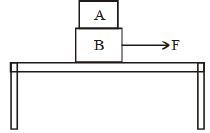
- 1Two blocks $A$ and $B$ of masses $m_A = 1\,kg$ and $m_B = 3\,kg$ are kept on the table as shown in figure. The coefficient of friction between $A$ and $B$ is $0.2$ and between $B$ and the surface of the table is also $0.2.$ The maximum force $F$ that can be applied on $B$ horizontal, so that the block $A$ does not slide over the block $B$ is ........ $N$. [Take $g = 10\,m/s^2$ ]View Solution
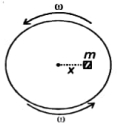
- 2A block of mass $m$ is kept on horizontal turn table at $x$ distance from the centre. If coefficient of friction between block and surface of turn table is $\mu$, then maximum angular speed of the table so that block does not slipView Solution
- 3A $1\,kg$ block is being pushed against a wall by a force $F = 75\,N$ as shown in the Figure. The coefficient of friction is $0.25.$ The magnitude of acceleration of the block is ........ $m/s^2$View Solution

- 4Assuming the coefficient of friction between the road and tyres of a car to be $0.5$, the maximum speed with which the car can move round a curve of $40.0\, m$ radius without slipping, if the road is unbanked, should be ......... $m/s$View Solution
- 5A particle of mass $m$ is at rest at the origin at time $t = 0$. It is subjected to a force $F(t) = F_0e^{-bt}$ in the $x$ -direction. Its speed $v(t)$ is depicted by which of the following curves ?View Solution
- 6A boy on a cycle pedals around a circle of $20\, metres$ radius at a speed of $20\,metres/\sec .$ The combined mass of the boy and the cycle is $90\, kg$. The angle that the cycle makes with the vertical so that it may not fall is ......... $^o$ $(g = 9.8\,m/{\sec ^2})$View Solution
- 7A uniform chain of $6\, m$ length is placed on a table such that a part of its length is hanging over the edge of the table. The system is at rest. The co-efficient of static friction between the chain and the surface of the table is $0.5$, the maximum length of the chain hanging from the table is.......$m.$View Solution
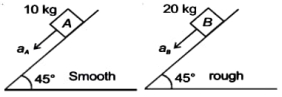
- 8The ratio of acceleration of blocks $A$ placed on smooth incline with block $B$ placed on rough incline is $2: 1$. The coefficient of kinetic friction between block $B$ and incline is .........View Solution
- 9A body starts from rest on a long inclined plane of slope $45^o$ . The coefficient of friction between the body and the plane varies as $\mu = 0.3\,x$ . where $x$ is distance travelled down the plane. The body will have maximum speed ( for $g = 10\,m/s^2$ ) when $x=$ ........ $m$View Solution
- 10Two stones of masses $m$ and $2\,m$ are whirled in horizontal circles, the heavier one in a radius $\frac{r}{2}$ and the lighter one in radius $r.$ The tangential speed of lighter stone is $n$ times that of the value of heavier stone when they experience same centripetal forces. The value of $n$ isView Solution