MCQ
In a Bainbridge mass spectrometer positive rays of the same element produce different traces. The traces correspond to:
- AIsotopes
- BIsobars
- CIsotones
- DNone of the above
Explanation:
In a Bainbridge mass spectrometer positive rays of the same element produce different traces. The traces correspond to isotopes. Isotopes are atoms of same element. They have same atomic number (nuclear charge) but different mass number (number of neutrons). Positive rays (or anode rays or canal rays) contains ions obtained by knocking out electrons from gaseous atoms.
Generate a complete, print-ready paper with questions like this in minutes — across 16+ boards, with answer keys.
The internal resistances of two cells shown are 0.1 Ω and 0.3 Ω. If R = 0.2 Ω, the potential difference across the cell

|
(a) B will be zero |
(b) A will be zero |
|
(c) A and B will be 2V |
(d) A will be > 2V and B will be < 2V |
Two capacitances of capacity  and
and  are connected in series and potential difference V is applied across it. Then the potential difference across will be
|
(a) |
(b) |
(c) |
(d) |
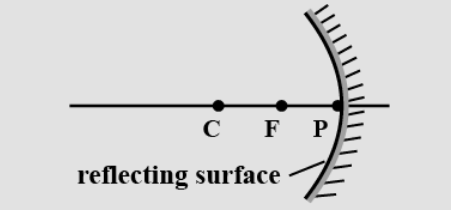
The distance CP is the:
In the Young’s double slit experiment with sodium light. The slits are 0.589 m a part. The angular separation of the third maximum from the central maximum will be (given 𝜆 = 589 mm)
|
(a) |
(b) |
(c) |
(d) |
A radioactive reaction is  →
→  . How many α and β particles are emitted
|
(a) 10α, 6β |
(b) 4 protons, 8 neutrons |
|
(c) 6 electrons, 8 protons |
(d) 6β, 8α |


