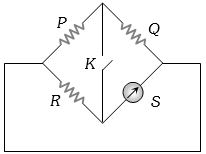
In a balanced Wheatstone’s network, the resistances in the arms $Q$ and $S$ are interchanged. As a result of this
Easy
Download our app for free and get started
We know that in In a balanced Wheatstone's network,
$\frac{ P }{ Q }=\frac{ R }{ S }$
If $Q$ is replaced by $S$ then ratio becomes $\frac{P}{S}=\frac{R}{Q}$ which is not equal to the previous ratio. Hence, network is not balanced.

Download our appand get started for free
Experience the future of education. Simply download our apps or reach out to us for more information. Let's shape the future of learning together!No signup needed.*
Similar Questions
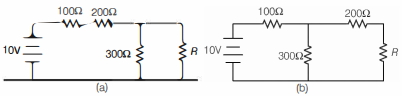
- 1A student was trying to construct the circuit shown in the figure below marked $(a)$, but ended up constructing the circuit marked $(b)$. Realising her mistake, she corrected the circuit, but to her surprise, the output voltage (across $R$ ) did not change. The value of resistance $R$ is ............ $\Omega$View Solution
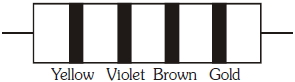
- 2View SolutionThe color code of a resistance is given below
The values of resistance and tolerance, respectively, are :
- 3In the following Wheatstone bridge $P/Q = R/S$. If key $K$ is closed, then the galvanometer will show deflectionView Solution
- 4For a metallic wire, the ratio $V/i$ ($V = $ the applied potential difference, $i$ = current flowing) isView Solution
- 5An unknown resistance $R_1$ is connected in series with a resistance of $10 \,\Omega$. This combinations is connected to one gap of a meter bridge while a resistance $R_2$ is connected in the other gap. The balance point is at $50\, cm$. Now, when the $10 \,\Omega$ resistance is removed the balance point shifts to $40\, cm$. The value of $R_1$ is (in $ohm$)View Solution
- 6A student measures the terminal potential difference $(V)$ of a cell $($ of $emf \;\varepsilon $ and internal resistance $r)$ as a function of the current $(I)$ flowing through it. The slope, and intercept, of the graph between $V$ and $I$, then, respectively, equalView Solution
- 7In $n_e$ and $v_d$ be the number of electrons and drift velocity in a semiconductor. When the temperature is increasedView Solution
- 8Resistances ${R_1}$ and ${R_2}$ are joined in parallel and a current is passed so that the amount of heat liberated is ${H_1}$ and ${H_2}$ respectively. The ratio $\frac{{{H_1}}}{{{H_2}}}$ has the valueView Solution
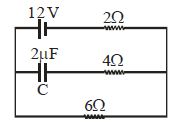
- 9Find the maximum charge on the capacitor $C$ in the following circuit ............ $\mu C$View Solution
- 10A steady current $I$ is set up in a wire whose cross-sectional area decreases in the direction of the flow of the current. Then, as we examine the narrowing region,View Solution