MCQ
In a biprism experiment using sodium light $\lambda = 6000\, Å$ an interference pattern is obtained in which $20$ fringes occupy $2\, cm$. On replacing sodium light by another source of wavelength $\lambda_2$ without making any other change $30$ fringes occupy $2.7\, cm$ on the screen. What is the value of $\lambda_2$?.......$\mathop A\limits^o $
  • A
    $4500$
  • $5400$
  • C
    $5600$
  • D
    $4200$

Answer

Correct option: B.
$5400$
b

Need a full question paper?

Generate a complete, print-ready paper with questions like this in minutes — across 16+ boards, with answer keys.

Start Generating Free

Similar questions

An experiment to verify ohm's law, a conductor of resistance $R$ is taken. During the experiment, temperature of the conductor increases with the flow of current. Resistance of the conductor will:
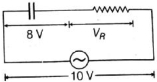
In a series $R$ $-$ $C$ circuit shown in figure, the applied voltage is $10\, V$ and the voltage across capacitor is found to be $8 \,V$. Then, the voltage across $R$ and the phase difference between current and the applied voltage will respectively be
The torque acting on a dipole of moment $\vec P$ in an electric field $\vec E$ is
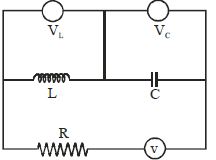
A series $R L C$ circuit is shown here. The source frequency $f$ is varied, but the current is kept unchanged. Which of the curves showing changes of $V_C$ and $V_L$ with frequency would be valid for  he circuit under consideration?
The probability of electrons to be found in the conduction band of an intrinsic semiconductor at a finite temperature
A long solenoid carrying a current produces a magnetic field B along its axis. If the current is doubled and the number of turns per cm is halved, the new value of the magnetic field is
Angle of dip is $90^\circ$ at
An X-ray tube with a copper target emits Cu $K_\alpha$ line of wavelength 1.50 Å. What should be the minimum voltage through which electrons are to be accelerated to produce this wavelength of X rays $(h = 6.63\times 10^{-34} \mathrm{~J}-\mathrm{sec}, \mathrm{c}=3 \times 10^8 \mathrm{~m} / \mathrm{s})$ 
There is an equiconvex glass lens with radius of each face as $R$ and $_a{\mu _g} = 3/2$ and $_a{\mu _w} = 4/3$. If there is water in object space and air in image space, then the focal length is
The angle of incidence at which reflected light is totally polarized for reflection from air to glass (refractive index n), is