MCQ
In a certain arrangement, a proton does not get deflected while moving through a magnetic field region. Under what condition is it possible?
  • $F = 0$
  • B
    $F = 180N$
  • C
    $F = -180N$
  • D
    $F = 3600N$

Answer

Correct option: A.
$F = 0$

Magnetic force on a proton is $\text{Fm}=\text{qv}\text{B}\sin(\theta).$
A proton moving parallel or antiparallel to a magnetic field does not experience any force.
Hence, the proton does not get deflected while moving through a magnetic field region.

Need a full question paper?

Generate a complete, print-ready paper with questions like this in minutes — across 16+ boards, with answer keys.
Start Generating Free

Similar questions

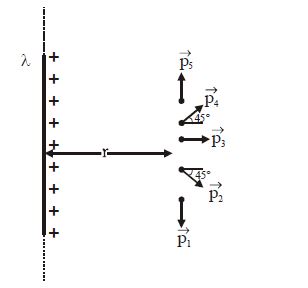
Five identical small electric dipoles are placed at a distance $r$ from an infinitely long straight wire carrying a uniform charge density $\lambda$.If they experience force of magnitude $F_1$, $F_2$, $F_3$, $F_4$ and $F_5$ respectively then
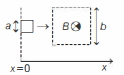
A square-shaped conducting wire loop of dimension moving parallel to the $X$-axis approaches a square region of size $b(a < b)$, where a uniform magnetic field $B$ exists pointing into the plane of the paper (see figure). As the loop passes through this region, the plot correctly depicting its speed $v$ as a function of $x$ is
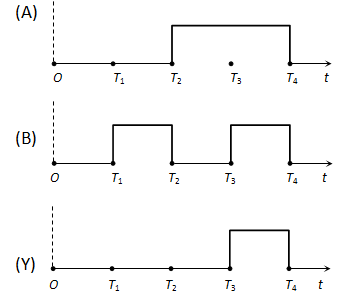
The given figure shows the wave forms for two inputs A and B and that for the output Y of a logic circuit. The logic circuit is
In hydrogen spectrum, the shortest wavelength in the Balmer series is $\lambda$. The shortest wavelength in the Bracket series is $........\,\lambda$
When a charged particle moving with velocity $\vec V$ is subjected to a magnetic field of induction $\vec B$ , the force on it is non-zero. This implies the
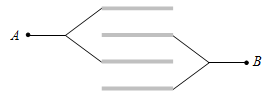
Four plates of the same area of cross-section are joined as shown in the figure. The distance between each plate is d. The equivalent capacity across A and B will be
A resistor $R_1$ dissipates the power P when connected to a certain generator. If the resistor $R_2$ is put in series with $R_1$, the power dissipated by $R_1$
An $A C$ voltage source of variable angular frequency $\omega$ and fixed amplitude $V_0$ is connected in series with a capacitance $\mathrm{C}$ and an electric bulb of resistance $\mathrm{R}$ (inductance zero). When $\omega$ is increased
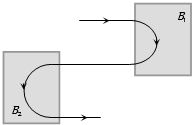
Following figure shows the path of an electron that passes through two regions containing uniform magnetic fields of magnitudes $B_1$ and $B_2$. It's path in each region is a half circle, choose the correct option
For a nucleus ${ }_Z^A X$ having mass number $A$ and atomic number $Z$

$A.$ The surface energy per nucleon $\left(b_s\right)=a_1 A^{2 / 3}$

$B.$ The Coulomb contribution to the binding energy $b_c=-a_2 \frac{Z(Z-1)}{A^{4 / 3}}$

$C.$ The volume energy $b_v=a_3 A$

$D.$ Decrease in the binding energy is proportional to surface area.

$E.$ While estimating the surface energy, it is assumed that each nucleon interacts with $12$ nucleons, $\left(a_1, a_2\right.$ and $a _3$ are constants)

Choose the most appropriate answer from the options given below: