Question
In a certain laboratory, scientists grow bacteria for research purposes. During a certain experiment, they rear bacteria in culture in a Petri dish. A particular strain of bacteria doubles in every 30 minutes. The scientists start with a single cell.
(1) How many bacteria will be there in the Petri dish after 12 hours?
(a) $2^{12}$$\quad$(b) $2^{18}$$\quad$(c) $2^{20}$$\quad$(d) $2^{24}$
(2) How many bacteria will be there in the Petri dish after 24 hours?
(a) $2^{24}$$\quad$(b) $2^{36}$$\quad$(c) $2^{40}$$\quad$(d) $2^{48}$
(3) If the Petri dish was full with bacteria after 24 hours, when was it half full?
(a) After 12 hours$\quad$(b) After 18 hours$\quad$(c) After 23 hours$\quad$(d) After 23 hours 30 minutes
(4) Had the scientists started with 1 cell each in two similar Petri dishes, how many bacteria would have been there in all after 12 hours?
(a) $2^{24}$$\quad$(b) $2^{25}$$\quad$(c) $2^{36}$$\quad$(d) $2^{48}$
(5) Had the scientists started with 2 cells in a Petri dish, how much time would they have saved in having a Petri dish full of bacteria?
(a) 30 minutes$\quad$(b) 1 hour$\quad$(c) 6 hours$\quad$(d) 12 hours
Answer

(1) (D) $2^{24}$
Number of bacteria after 30 minutes $=2$.
Number of bacteria after two $30- min$ slots (i.e., 1 hour) $=2 \times 2=2^2$.
Number of bacteria after three $30- min$ slots (i.e., $1 \frac{1}{2}$ hours) $=2^2 \times 2=2^3$.
Number of bacteria after 24 slots of 30 min each (i.e., 12 hours) $=2^{24}$.
(2) (D) $2^{48}$
As shown above, number of bacteria after 48 slots of 30 min each (i.e., 24 hours) $=2^{48}$
(3) (D) After 23 hours 30 minutes
Since bacteria double after 30 minutes, so they were half in number 30 minutes before 24 hours, i.e., 23 hours 30 min .
(4) (B) $2^{25}$
$\begin{aligned} \text { Total number of bacteria in } 2 \text { Petri dishes after } 12 \text { hours } & =2^{24}+2^{24}=2 \times 2^{24} \\ & =2^{(1+34)}=2^{25} .\end{aligned}$
(5) (A) 30 minutes
On starting with 2 cells, there would be $2^{48}$ cells after 47 slots of 30 min each, i.e., after 23 hours 30 min . So, time saved $=30 min$.

Need a full question paper?

Generate a complete, print-ready paper with questions like this in minutes — across 16+ boards, with answer keys.

Start Generating Free

Similar questions

Three quantities $x, y$ and $z$ are such that $x$ and $y$ are directly proportional to each other while $y$ and $z$ are inversely proportional to each other. If $x=12$ then $y=72$ and $z=8$.

(1) If $y=42$ then $x$ is equal to
(a) 6
(b) 7
(c) 8
(d) 10

(2) If $z=12$ then $y$ is equal to
(a) 36
(b) 48
(c) 60
(d) 64

(3) Which of the following cannot be a possible combination of the values of $x$ and $y$ ?
(a) 6.5 and 39
(b) 9 and 54
(c) 47 and 282
(d) 52 and 260

(4) If $x=24$ then $z$ is equal to
(a) 4
(b) 6
(c) 8
(d) 12
Find the least number which must be added to each of the following numbers so as to get a perfect square. Also find the square root of the perfect square so obtained.$1750$
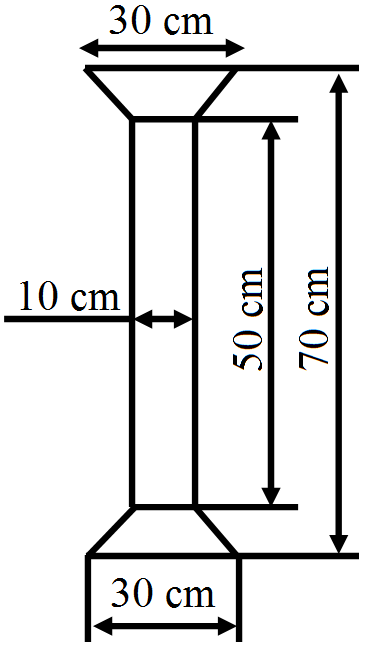
Find the area of Fig. as the sum of the areas of two trapezium and a rectangle.
Due to the effect of special campaign about 'saving water by state JAL BOARD. Find an average urban Indian uses about 150 L of water every day which is reduces to $10\%.$
The consumption of daily use of water given below
ActivitiesLitres per peson per day
Driking3
Cooking4
Bathing20
Sanitation40
Washing clothes40
Washing utensils20
Gardening23
Total150
(i) What per cent of water is used for bathing and sanitation together per day?
(ii) How much less per cent of water is used for cooking in comparison to that used for bathing?
(iii) What per cent of water is used for drinking, cooking and gardening together?
(iv) What value is depicted from the 'saving water'?
For each of the following numbers, find the smallest whole number by which it should
be divided so as to get a perfect square. Also find the square root of the square
number so obtained.$396$
Find five rational numbers between$\frac{2}{3}\text{and}\frac{4}{5}$
Find the least number which must be subtracted from each of the following numbers so as to get a perfect square. Also find the square root of the perfect square so obtained.$1989$
Find the number of digits in the square root of each of the following numbers (without any calculation).$27225$
Find the least number which must be added to each of the following numbers so as to get a perfect square. Also find the square root of the perfect square so obtained.$1825$
Find the square root of each of the following numbers by Division method.$3136$