Question
Find five rational numbers between$\frac{2}{3}\text{and}\frac{4}{5}$

Answer

$\frac{2}{3}\text{ and }\frac{4}{5}$ can be represented as $\frac{30}{45}\text{ and }\frac{36}{45}$ respectively.
Therefore, five rational numbers between $\frac{2}{3}\text{ and }\frac{4}{5}$ are
$\frac{31}{45},\frac{32}{45},\frac{33}{45},\frac{34}{45},\frac{35}{45}$

Need a full question paper?

Generate a complete, print-ready paper with questions like this in minutes — across 16+ boards, with answer keys.
Start Generating Free

Similar questions

Fill in the blanks to make the given statement true. All point with $y-$coordinate as $0$ lie on ________.
Find the square root of each of the following numbers by Division method.$5776$
Find the square root of each of the following numbers by Division method. $2304$
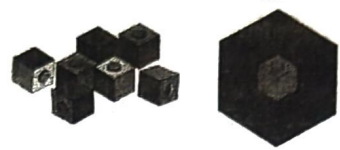
Interlocking cubes come in different colours. Different shapes can be created by joining them.
Image
Sasha is making large cube using small interlocking cubes. She starts with a yellow cube and then fits one layer of red cubes around it to make the large cube.
On the basis of above given information, answer the following questions.

(i) What is the number of red cubes used?
(a) 9 $~~\quad$ (b) 18
(c) 26 $\quad$ (d) 27

(ii) Sasha considers the red layer as the first layer on the yellow cube. Which equation can be used to find the number of red cubes?
(a) $6 x^2$ $~\qquad$ (b) $x^3$
(c) $x^3+1$ $\quad$ (d) $2(x+2)^2+4 x^2$
(iii) The red cube is surrounded by a layer of green cubes. The resulting figure is also a cube. What is the number of green cubes used?
(iv) Shubham puts $\text x$ layers around the yellow cube. How many small cubes did he use on the top-most face of the large cube so formed?
Find the square root of each of the following numbers by Division method.$7921$
Due to the effect of special campaign about 'saving water by state JAL BOARD. Find an average urban Indian uses about 150 L of water every day which is reduces to $10\%.$
The consumption of daily use of water given below
ActivitiesLitres per peson per day
Driking3
Cooking4
Bathing20
Sanitation40
Washing clothes40
Washing utensils20
Gardening23
Total150
(i) What per cent of water is used for bathing and sanitation together per day?
(ii) How much less per cent of water is used for cooking in comparison to that used for bathing?
(iii) What per cent of water is used for drinking, cooking and gardening together?
(iv) What value is depicted from the 'saving water'?
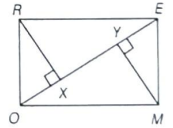
A rectangular MORE is shown below :
Image
Answer the following questions by giving appropriate reason.
(i) Is $R E=O M?$
(ii) Is $\angle MYO =\angle R X E?$
(iii) Is $\angle M O Y=\angle R E X?$
(iv) Is $\triangle M Y O \cong \triangle R X E?$
Three quantities $x, y$ and $z$ are such that $x$ and $y$ are directly proportional to each other while $y$ and $z$ are inversely proportional to each other. If $x=12$ then $y=72$ and $z=8$.

(1) If $y=42$ then $x$ is equal to
(a) 6
(b) 7
(c) 8
(d) 10

(2) If $z=12$ then $y$ is equal to
(a) 36
(b) 48
(c) 60
(d) 64

(3) Which of the following cannot be a possible combination of the values of $x$ and $y$ ?
(a) 6.5 and 39
(b) 9 and 54
(c) 47 and 282
(d) 52 and 260

(4) If $x=24$ then $z$ is equal to
(a) 4
(b) 6
(c) 8
(d) 12
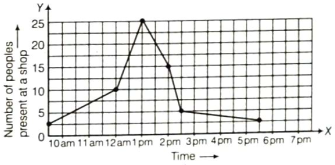
The following graph shows the number of people present at a certain shop at different times. Observe the graph and answer the following questions.
Image
(i) What type of graph is this?
(ii) What information does the graph give?
(iii) What is the busiest time of day at the shop?
(iv) How many people enter the shop when it opens