In a certain region of space, variation of potential with distance from origin as we move along $x$-axis is given by $V=8 x^2+2$, where $x$ is the $x$-coordinate of a point in space. The magnitude of electric field at a point $(-4,0)$ is .......... $V / m$
Easy
Download our app for free and get started
(d)
$V=8 x^2+2$
$E_x=\frac{-d V}{d x}=-16 x$
$x=-4$
$E_x=64 \,V / m$

Download our appand get started for free
Experience the future of education. Simply download our apps or reach out to us for more information. Let's shape the future of learning together!No signup needed.*
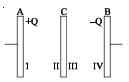
Similar Questions
- 1A molecule of a substance has permanent dipole moment $p$. A mole of this substance is polarised by applying a strong electrostatic field $E$. The direction of the field is suddenly changed by an angle of $60^{\circ} .$ If $N$ is the Avogadro's number the amount of work done by the field isView Solution
- 2Charge of $2Q$ and $-Q$ are placed on two plates of a parallel plate capacitor. If capacitance of capacitor is $C$, potential difference between the plates isView Solution
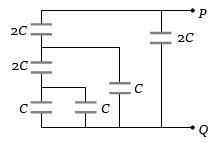
- 3View SolutionThe resultant capacitance of given circuit is
- 4The plates of parallel plate capacitor are charged upto $100\;V$. A $2\,mm$ thick plate is inserted between the plates. Then to maintain the same potential difference, the distance between the plates is increased by $1.6\;mm$. The dielectric constant of the plate isView Solution
- 5A condenser of $2\,\mu F$ capacitance is charged steadily from $0$ to $5$ $Coulomb$. Which of the following graphs correctly represents the variation of potential difference across its plates with respect to the charge on the condenserView Solution
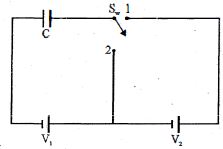
- 6The switch $S_w$ is shifted from position $1$ to position $2$ as shown in the figure. Heat generated in the circuit isView Solution
- 7Consider two charged metallic spheres $S_{1}$ and $\mathrm{S}_{2}$ of radii $\mathrm{R}_{1}$ and $\mathrm{R}_{2},$ respectively. The electric $\left.\text { fields }\left.\mathrm{E}_{1} \text { (on } \mathrm{S}_{1}\right) \text { and } \mathrm{E}_{2} \text { (on } \mathrm{S}_{2}\right)$ on their surfaces are such that $\mathrm{E}_{1} / \mathrm{E}_{2}=\mathrm{R}_{1} / \mathrm{R}_{2} .$ Then the ratio $\left.\mathrm{V}_{1}\left(\mathrm{on}\; \mathrm{S}_{1}\right) / \mathrm{V}_{2} \text { (on } \mathrm{S}_{2}\right)$ of the electrostatic potentials on each sphere isView Solution
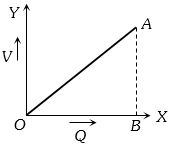
- 8Change $Q$ on a capacitor varies with voltage $V$ as shown in the figure, where $Q$ is taken along the $X$-axis and $V$ along the $Y$-axis. The area of triangle $OAB$ representsView Solution
- 9Two capacitors with capacitance values $C _1=2000 \pm 10 pF$ and $C_2=3000 \pm 15 pF$ are connected in series. The voltage applied across this combination is $V=5.00 \pm 0.02 V$. The percentage error in the calculation of the energy stored in this combination of capacitors is . . . . . .View Solution
- 10Plates $A$ and $B$ constitute an isolated, charge parallel-plate capacitor. The inner surfaces ($I$ and $IV$) of $A$ and $B$ have charges $+Q$ and $-Q$ respectively. Athird plate $C$ with charge $+$$Q$ is now introduced midway between $A$ and $B$. Which of the following statements is not correct?View Solution