Question
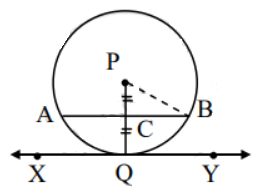
In a circle with centre $P ,$ chord $AB$ is parallel to a tangent and intersects the radius drawn from the point of contact to its midpoint. If $AB = 16\sqrt3$ then find the radius of the circle
Answer

Image
Given: Chord $A B||$ tangent $X Y$
$A B=16 \sqrt{3}$  units 
$PQ$ is radius of the circle.
$P C=C Q$
To find: Radius of the circle, $i.e.,I(PQ)$
Construction: Draw seg $PB.$
In given figure, $ \angle P Q Y=90^{\circ}..(i) [$Tangent theorem$]$
Chord $A B \|$ line $X Y$
$\therefore \angle PCB \cong \angle PQY$
$\therefore \angle PCB =90^{\circ}(ii) ...[$From $(i)]$
Now $C B=\frac{1}{2} A B$
$ \begin{array}{l} \therefore C B=\frac{1}{2} \times 16 \sqrt{3} \ldots . .\left[\begin{array}{c} \text { A perpendicular drawn from the } \\ \text { centre of a circle on its chord } \\ \text { bisects the chord } \end{array}\right] \\\end{array}$
$C B=8 \sqrt{3}....(iii) $
Let the radius of the circle be $x$ units
$\therefore PQ = x$
$\therefore PC =\frac{1}{2} PQ \ldots \ldots . .[ PC = CQ , P - C - Q ]$
$\therefore PC =\frac{1}{2} x \ldots \ldots . (v)$
$\text { In } \triangle PCB ,$
$\angle PCB =90^{\circ} \ldots . .[$From $(ii)] $
$\therefore PB P ^2= PC ^2+ CB ^2 \ldots . .[$ Pythagoras theorem $]$
$\therefore x ^2=\left(\frac{1}{2} x\right)^2+(8 \sqrt{3})^2 \ldots . . .[$ From $(iii), (iv)$ and $( v )]$
$\therefore x ^2=\frac{x^2}{4}+64 \times 3$
$\therefore 4 x^2=x^2+192$
$\therefore 4 x ^2- x ^2=192$
$\therefore 3 x^2=192$
$\therefore x ^2=\frac{192}{3}$
$\therefore x^2=64$
$\therefore x =8$ units $[$Taking square root of both sides$]$
$\therefore$ The radius of the circle is $8$ units.

Need a full question paper?

Generate a complete, print-ready paper with questions like this in minutes — across 16+ boards, with answer keys.
Start Generating Free

Similar questions


Image
A businessman bought some items for ₹ 600. Keeping 10 items for himself he sold the remaining items at a profit of ₹ 5 per item. From the amount received in this deal he could buy 15 more items. Find the original price of each item.
Two different dice are thrown together. Find the probability that:
  1. The sum of the numbers appeared is less than 7.
  2. The product of the numbers appeared is less than 18.
Cards numbered 1 to 30 are put in a bag. A card is drawn at random from the bag. Find the probability that the number on the drawn card is:
  1. Not divisible by 3.
  2. A prime number greater that 7.
  3. Not a perfect square number.
Two different dice are thrown together. Find the probability that the numbers obtained:
  1. Have a sum less than 7.
  2. Have a product less than 16.
  3. Is a doublet of odd numbers.
A solid metallic sphere of diameter 28cm is melted and recast into a number of smaller cones, each of diameter $4\frac{2}{3}\text{cm}$ and height 3cm. Find the number of cones so formed.
Construct a triangle $PQR$ with sides $QR = 7\ cm, PQ = 6\ cm$ and $ \angle\text{PQR} = 60^\circ.$ Then construct another triangle whose sides are $\frac{3}{5}$ of the corresponiding sides of $\triangle\text{PQR}.$
In an A.P. the first term is $8, n^{th}$ term is $33$ and the sum to first n terms is $123$. Find n and d, the common differences.
Four points A(6, 3), B(-3, 5), C(4, -2) and D(x, 3x) are given in such a way that $\frac{\triangle\text{DBC}}{\triangle\text{ABC}}=\frac{1}{2},$ find x.
Prove the following identities:
$\frac{\sin\theta-\cos\theta}{\sin\theta+\cos\theta}+\frac{\sin\theta+\cos\theta}{\sin\theta-\cos\theta}=\frac{2}{\big(2\sin^2\theta-1\big)}$