Question
In a Coolidge tube, electrons strike the target and stop inside it. Does the target get more and more negatively charged as time passes?

Answer

An electron emitted from the filament undergoes a number of collisions inside the material and loses its kinetic energy before coming to rest. This energy is utilised to give out photons or reject electrons from the atoms of the target. These electrons move to the battery connected to the circuit. Thus, the target does not get more and more negatively charged as time passes.

Need a full question paper?

Generate a complete, print-ready paper with questions like this in minutes — across 16+ boards, with answer keys.
Start Generating Free

Similar questions

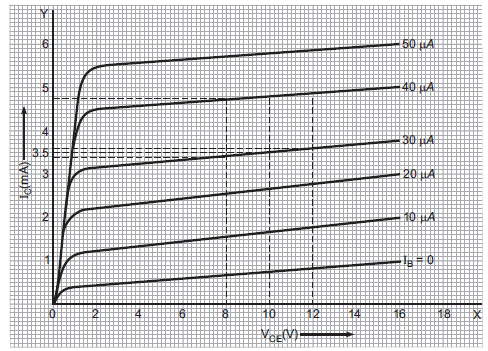
Output characteristics of an n-p-n transistor in CE configuration is shown in the figure. Determine:
  1. Dynamic output resistance.
  2. Dc current gain and.
  3. Ac current gain at an operating point $V_{CE} = 10V$, when $I_B =30 \mu A.$
A mixture contains 1 mole of helium $(C_p = 2.5R, C_v = 1.5R)$ and 1 mole of hydrogen $(C_p= 3.5R, C_v= 2.5R).$ Calculate the values of $C_p, C_v$ and $\gamma$ for the mixture.
The magnetic intensity Hat the centre of a long solenoid carrying a current of 2.0A, is found to be 1500A/m. Find the number of turns per centimetre of the solenoid.
A flint glass prism and a crown glass prism are to be combined in such a way that the deviation of the mean ray is zero. The refractive index of flint and crown glasses for the mean ray are 1.620 and 1.518 respectively. If the refracting angle of the flint prism is 6.0°, what would be the refracting angle of the crown prism?
Find the time required for a 50Hz alternating current to change its value from zero to the rms value.
Two equal charges are placed at a separation of 1.0m. What should be the magnitude of the charges so that the force between them equals the weight of a 50kg person?
A charged metallic sphere A is suspended by a nylon thread. Another charged metallic sphere B held by an insulating
Image
handle is brought close to A such that the distance between their centres is 10 cm, as shown in Fig. 1.4(a). The resulting repulsion of A is noted (for example, by shining a beam of light and measuring the deflection of its shadow on a screen). Spheres A and B are touched by uncharged spheres C and D respectively, as shown in Fig. 1.4(b). C and D are then removed and B is brought closer to A to a distance of 5.0 cm between their centres, as shown in Fig. 1.4(c). What is the expected repulsion of A on the basis of Coulomb’s law? Spheres A and C and spheres B and D have identical sizes. Ignore the sizes of A and B in comparison to the separation between their centres.
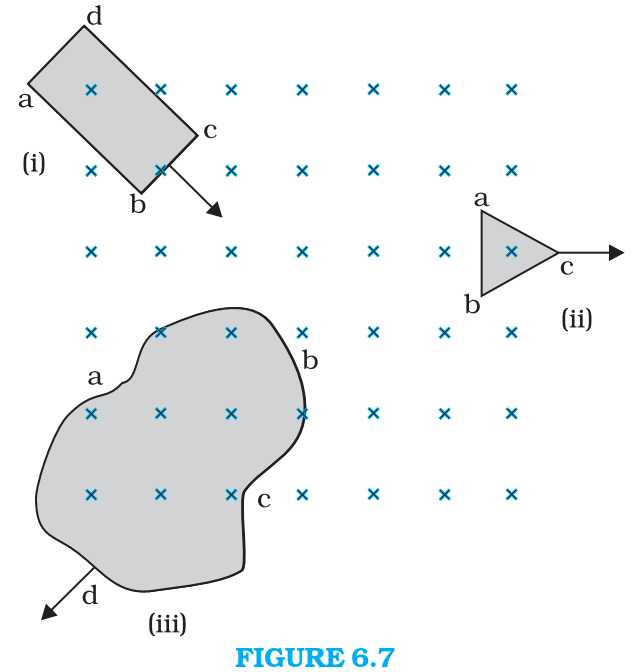
shows planar loops of different shapes moving out of or into a region of a magnetic field which is directed normal to the plane of the loop away from the reader. Determine the direction of induced current in each loop using Lenz's law.
Image
Define the term self$-$inductance of a solenoid. Obtain the expression for the magnetic energy stored in an inductor of self$-$inductance $L$ to build up a current $I$ through it.
Give a circuit diagram of a common emitter amplifier using an n-p-n transistor. Draw the input and output waveforms of the signal. Write the expression for its voltage gain.