Question
In a corner of a rectangular field with dimensions 35m × 22m, a well with 14m inside diameter is dug 8m deep. The earth dug out is spread evenly over the remaining part of the field. Find the rise in the level of the field.

Answer

We have,
Length of the fie!, l = 35m,
Width of the field, b = 22m,
Depth of the well, H = 8m and
Radius of the well, $\text{R}=\frac{14}{2}=7\text{m},$
Let the rise in the level of the field be h.
Now,
Volume of the earth on remaining part of the field= Volume of earth dug out
⇒ Area of the remaining field × h = Volume of the well
⇒ (Area of the field-Area of base of the well) $\times\text{h}\pi\text{R}^2\text{H}$
$\Rightarrow(\text{lb}-\pi\text{R}^2)\times\text{h}=\pi\text{R}^2\text{H}$
$\Rightarrow(35\times22-\frac{22}{7}\times7\times7)\times\text{h}=\frac{22}{7}\times7\times7\times8$
$=(770-154)\times\text{h}=1232$
$\Rightarrow616\times\text{h}=1232$
$\Rightarrow\text{h}=\frac{1232}{616}$
$\therefore\text{h}=2\text{m}$
So, the rise in the level of the field is 2m.

Need a full question paper?

Generate a complete, print-ready paper with questions like this in minutes — across 16+ boards, with answer keys.
Start Generating Free

Similar questions

A horse is placed for grazing inside a reangular field 70m by 2m. It is tethered to one comer by a rope 21m long. On how much area an it graze? How much area is left ungrazed? $\Big[\text{Use }\pi=\frac{22}{7}\Big]$
Prove that:
$\left(\frac{1+\tan ^2 A}{1+\cot ^2 A}\right)=\frac{(1-\tan A)^2}{(1-\cot A)^2}$
If $\theta=30^\circ,$ verify that.
$\cos2\theta=\frac{1-\tan^2\theta}{1+\tan^2\theta}$
If $\tan\theta=\frac{12}{13},$ find the value of $\frac{2\sin\theta\cos\theta}{\cos^2\theta-\sin^2\theta}.$
A hemispherical depression is cut out from one face of a cubical wooden block of edge $21\ cm$, such that the diameter of the hemisphere is equal to the edge of the cube. Determine the volume and total surface area of the remaining block.
Two cubes each of volume $125cm^3$​​​​​​​ are joined end to end to form a solid. Find the surface area of the resulting cuboid.
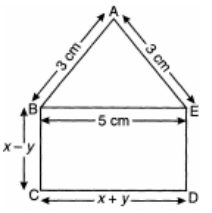
In the figure below $\text{ABCDE}$ is a pentagon with $BE \| CD$ and $BC \| DE. BC$ is perpendicular to $CD$. If the perimeter
of $\text{ABCDE}$ is $21 \ cm,$ find the Values of $x$ and $y$.
Image
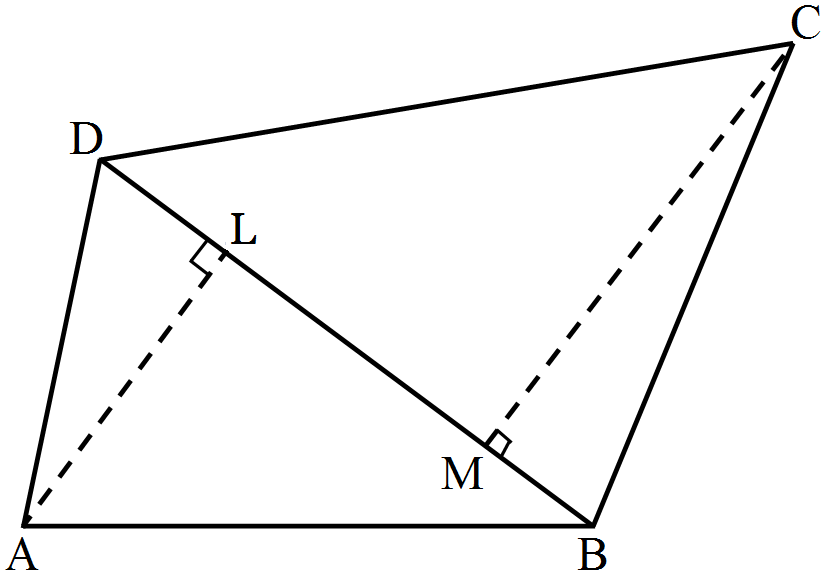
In the given figure, ABCD is a quadrilateral in which diagonal BD = 24cm,$\text{AL}\perp\text{BD}$ and $\text{CM}\perp\text{BD}$ such that AL = 9cm and CM = 12cm. Calculate the area of the quadrilateral.
Prove the following trigonometric identities.
$\frac{1+\cos\theta+\sin\theta}{1+\cos\theta-\sin\theta}=\frac{1+\sin\theta}{\cos\theta}$
At t minutes past $2$ pm, the time needed by the minutes hand of a clock to show $3$ pm was found to be $3$ minutes less than $\frac{\text{t}^2}{4}$ minutes. Find t.