Question
In a cyclic quadrilateral ABCD $\angle\text{A}=(2\text{x}+4)^\circ,\angle\text{B}=(\text{y}+3)^\circ,$ $\angle\text{C}=(2\text{y}+10)^\circ,\angle\text{D}=(4\text{x}-5)^\circ.$ Find the four angles.
Answer

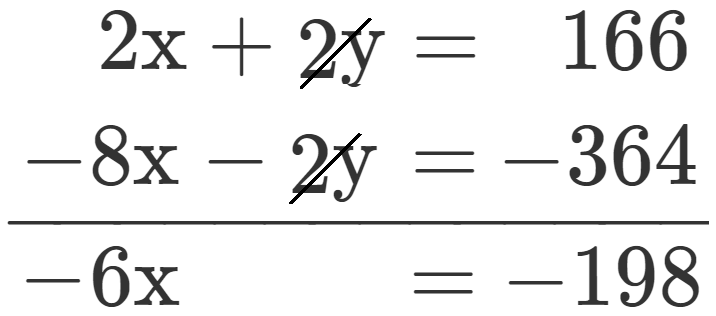
We know that the sum of the opposite angles of cyclic quadrilateral is 180°. in the cyclic quadrilateral ABCD, angles A and C and angles B and D pairs of opposite angles. Therefore $\angle\text{A}+\angle\text{C}=180^\circ$ By substituting $\angle\text{A}=(2\text{x}+4)^\circ$ and $\angle\text{C}=(2\text{y}+10)^\circ$ we get 2x + 4 + 2y + 10 = 180 2x + 2y + 14 = 180° 2x + 2y = 180° - 14° 2x + 2y = 166 .....(i) Taking $\angle\text{B}+\angle\text{D}=180^\circ$ By substituting $\angle\text{B}=(\text{y}+3)^\circ$ and $\angle\text{D}=(4\text{x}-5)^\circ$ we get y + 3 + 4x - 5 = 180° 4x + y - 5 + 3 = 180° 4x + y - 2 = 180° 4x + y = 180° + 2° 4x + y = 182° .....(ii) By multiplying equation (ii) by 2 we get 8x + 2y = 364 .....(iii) By subtracting equation (iii) from (i) we get
$\text{x}=\frac{-198}{-6}$ x = 33° By substituting x = 33° in equation (ii) we get 4x + y = 182 4 × 33 + y = 182 132 + y = 182 y = 182 - 132 y = 50 The angles of a cyclic quadrilateral are $\angle\text{A}=2\text{x}+4$ = 2 × 33 + 4 = 66 + 4 = 70° $\angle\text{B}=\text{y}+3$ = 50 + 3 = 53° $\angle\text{C}=2\text{y}+10^\circ$ = 2 × 50 + 10 = 100 + 10 = 110° $\angle\text{D}=4\text{x}-5$ = 4 × 33 - 5 = 132 - 5 = 127° Hence, the angles of cyclic quadrilateral ABCD are $\angle\text{A}=70^\circ,\angle\text{B}=53^\circ,\angle\text{C}=110^\circ,\angle\text{D}=127^\circ$

Need a full question paper?

Generate a complete, print-ready paper with questions like this in minutes — across 16+ boards, with answer keys.
Start Generating Free

Similar questions

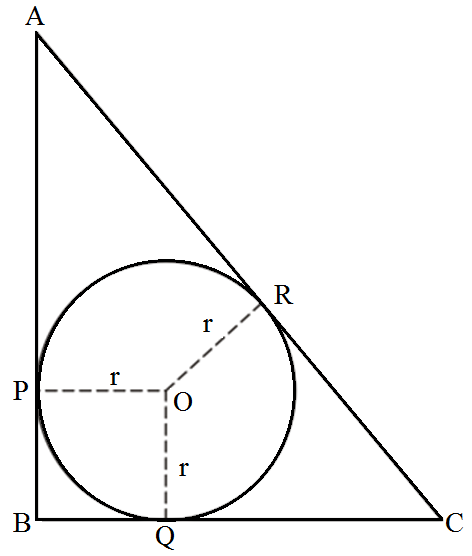
In the given figure, $ABC$ is a right triangle right-angled at $B$ such that $BC = 6cm$ and $AB = 8cm$. Find the radius of its in circle.
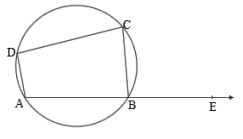
In the figure $\square ​​​​ABCD$ is a cyclic quadrilateral. If $m($arc $ABC) = 230^\circ.$ then find $\angle ABC ,\angle CDA ,\angle CBE$
Image
A train travels $360\ km$ at a uniform speed. If the speed had been 5km/hr more, it would have taken $1$ hour less for the same journey. Find the speed of the train.
Find the quotient and the remainder when:
$f(x) = x^4 - 5x + 6$ is divided by $g(x) = 2 - x^2$
The sum of the reciprocals of Meena's ages (in years) $3$ years ago and $5$ years hence is $\frac{1}{3}.$ Find her present age.
Following is the breakup of expenditure of a family on different times of consumption.
ItemFoodClothingRentEducationFuelMedicineMiscellaneous
Expenditure in ₹160020060015010080270
Draw a pie diagram of the above data.
Solve the following quadratic equations by factorization:
$\frac{\text{m}}{\text{n}}\text{x}^2+\frac{\text{n}}{\text{m}}=1-2\text{x}$
A solid is composed of a cylinder with hemispherical ends. If the length of the whole solid is 108cm and the diameter of the cylinder is 36cm, find the cost of polishing the surface at the rate of 7 paise per $cm^2.$
$\frac{5}{x-1}+\frac{1}{y-2}=2 ; \frac{6}{x-1}-\frac{3}{y-2}=1$
Let there be an A.P. with first term ' $a$ ', common difference ' $d$ '. If $a_n$ denotes in $n^{\text {th }}$ term and $S_n$ the sum of first $n$ terms, find.
$n$ and $S_n$, if $a=5, d=3$ and $a_n=50$.