MCQ
In a cyclotron, a charged particle
  • Undergoesd acceleration all the time
  • B
    Speeds up between the dees because of the magnetic field
  • C
    Speeds up in a dee
  • D
    Slows down within a dee and speeds up between dees

Answer

Correct option: A.
Undergoesd acceleration all the time
a
The charged particle undergoes acceleration as
$(i)$ Speeds up between the dees because of the oscillating electric field and
$(ii)$ Speed remains the same inside the dees because of the magnetic field but direction undergoes change continuously.

Need a full question paper?

Generate a complete, print-ready paper with questions like this in minutes — across 16+ boards, with answer keys.

Start Generating Free

Similar questions

 A steel wire is stretched with a definite load. If the Young's modulus of the wire is $Y$. For decreasing the value of $Y$
A $12\,pF$ capacitor is connected to a $50\,V$ battery. How much electrostatic energy is stored in the capacitor
$A$ copper rod $AB$ of length $L$, pivoted at one end $A$, rotates at constant angular velocity $\omega$ , at right angles to $a$ uniform magnetic field of induction $B$. The $e.m.f$ developed between the mid point $C$ of the rod and end $B$ is
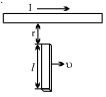
$A$ conducting rod of length $l$ moves with velocity $\upsilon$ a direction parallel to a long wire carrying a steady current $I$. The axis of the rod is maintained perpendicular to the wire with near end $a$ distance $r$ away as shown in the fig. Find the emf induced in the rod.
Two identical solid copper spheres of radius $R$ placed in contact with each other. The gravitational attracton between them is proportional to
The self inductance of a solenoid of length $L$, area of cross-section $A$ and having $N$ turns is
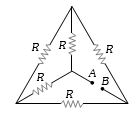
Each of the resistance in the network shown in fig. is equal to $R$. The resistance between the terminals $A$ and $B$ is
The radius of a thin wire is $0.16\; mm$. The area of cross-section taking significant figure into consideration in square millimeters is?
Two lenses have focal lengths ${f_1}$ and ${f_2}$ and their dispersive powers are ${\omega _1}$ and ${\omega _2}$ respectively. They will together form an achromatic combination if
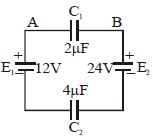
Two capacitors $C_1$ and $C_2$ are connected in a circuit as shown in figure. The potential difference $(V_A -V_B)$ is....$V$