MCQ
In a cyclotron experiment, if we assume that maximum radius attained by any charged particle is equal to radius of dees, then minimum kinetic energy gained by the particles will be for
  • A
    Alpha particle
  • B
    Proton
  • C
    Deutron
  • D
    Same of all

Answer

$K{E_{\max }}\, \propto \,\,\frac{{{q^2}}}{m}$

so, it is minimum for deutron.

Need a full question paper?

Generate a complete, print-ready paper with questions like this in minutes — across 16+ boards, with answer keys.
Start Generating Free

Similar questions

Which of the following wavelength falls in $X$-ray region
Consider two hot bodies $B_1$ and $B_2$ which have temperatures $100^{\circ} \mathrm{C}$ and $80^{\circ} \mathrm{C}$ respectively at $t=0$. The temperature of the surroundings is $40^{\circ} \mathrm{C}$. The ratio of the respective rates of cooling $R_1$ and $R_2$ of these two bodies at $t=0$ will be
A piece of blue glass heated to a high temperature and a piece of red glass at room temperature, are taken inside a dimly lit room then
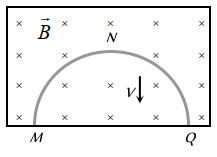
A thin semicircular conducting ring of radius $R$ is falling with its plane vertical in a horizontal magnetic induction $B$. At the position $M N Q$, the speed of the ring is $V$ and the potential difference developed across the ring is
Image
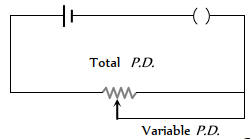
The arrangement as shown in figure is called as

Image

$5$ amperes of current is passed through a metallic conductor. The charge flowing in one minute in coulombs will be
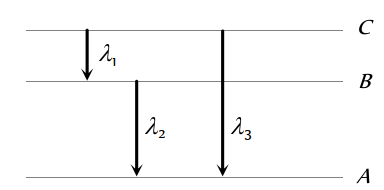
Energy levels $A, B, C$ of a certain atom corresponding to increasing values of energy i.e. $E_A<E_B<E_C$. If $\lambda_1, \lambda_2, \lambda_3$ are the wavelengths of radiations corresponding to the transitions $C$ to $B, B$ to $A$ and $C$ to $A$ respectively, which of the following statements is correct
Image
An automobile travelling with a speed of $60\  km / h$, can brake to stop within a distance of $20\  m$. If the car is going twice as fast, i.e. $120\  km / h$, the stopping distance will be
In variable state, the rate of flow of heat is controlled by
Two kg of water is converted into steam by boiling at atmospheric pressure. The volume changes from $2 \times 10^{-3} \mathrm{~m}^3$ to $3.34 \mathrm{~m}^3$. The work done by the system is about