In a cylindrical container open to the atmosphere from the top a liquid is filled upto $10\,\, m$ depth. Density of the liquid varies with depth from the surface as $\rho (h) = 100 + 6h^2$ where $h$ is in meter and $\rho$ is in $kg/m^3.$ The pressure at the bottom of the container will be : $($ atmosphere pressure $= 10^5\,\, Pa, \,g = 10\, m/sec^2)$
Diffcult
Download our app for free and get started
$p=\int_{x}^{E} \rho g d y+p_{0}$
$=10 \times \int_{0}^{10}\left(100+6 \mathrm{R}^{2}\right) \mathrm{d} \mathrm{h}+10^{5}$
$=10^{4}+2 \times 10^{4}+10^{5}=1.3 \times 10^{5} \mathrm{Pa}$

Download our appand get started for free
Experience the future of education. Simply download our apps or reach out to us for more information. Let's shape the future of learning together!No signup needed.*
Similar Questions
- 1An object with uniform density $\rho$ is attached to a spring that is known to stretch linearly with applied force as shown below.When the spring object system is immersed in a liquid of density $\rho_1$ as shown in the above figure, the spring stretches by an amount $x_1\left(\rho > \rho_1\right)$. When the experiment is repeated in a liquid of density $\left(\rho_2 < \rho_1\right)$, the spring stretches by an amount $x_2$. Neglecting any buoyant force on the spring, the density of the object isView Solution
- 2A sphere of relative density $\sigma$ and diameter $D$ has concentric cavity of diameter $d$. The ratio of $\frac{D}{d}$, if it just floats on water in a tank is:View Solution
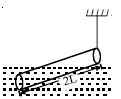
- 3A slender homogeneous rod of length $2L$ floats partly immersed in water, being supported by a string fastened to one of its ends, as shown. The specific gravity of the rod is $0.75$. The length of rod that extends out of water is :View Solution
- 4A barometer kept in an elevator reads $76 \,cm$ when it is at rest. If the elevator goes up with some acceleration, the reading will be .......... $cm$View Solution
- 5View SolutionA liquid is flowing in a horizontal pipe of non-uniform cross section. Which of the following quantities may remain unchanged with respect to time?
- 6Two solids $A$ and $ B$ float in water. It is observed that $A$ floats with half its volume immersed and $B$ floats with $2/3$ of its volume immersed. Compare the densities of $A$ and $B$View Solution
- 7A small hole of area of cross-section $2\; \mathrm{mm}^{2}$ is present near the bottom of a fully filled open tank of height $2\; \mathrm{m} .$ Taking $\mathrm{g}=10 \;\mathrm{m} / \mathrm{s}^{2},$ the rate of flow of water through the open hole would be nearly ......... $\times 10^{-6} \;m^{3} /s$View Solution
- 8An air bubble of $1\, cm$ radius is rising at a steady rate of $2.00\, mm/sec$ through a liquid of density $1.5\, gm$ per $cm^3$. Neglect density of air. If $g$ is $1000\, cm/sec^2$, then the coefficient of viscosity of the liquid isView Solution
- 9Water flows in a streamlined manner through a capillary tube of radius $a$, the pressure difference being $P$ and the rate of flow $Q$. If the radius is reduced to $a/2$ and the pressure increased to $ 2P, $ the rate of flow becomesView Solution
- 10A ball of mass $m$ and radius $ r $ is gently released in a viscous liquid. The mass of the liquid displaced by it is $m' $ such that $m > m'$. The terminal velocity is proportional toView Solution