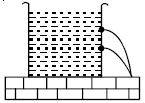
In a cylindrical vessel containing liquid of density $\rho $, there are two holes in the side walls at heights of $ h_1$ and $h_2$ respectively such that the range of efflux at the bottom of the vessel is same. The height of a hole, for which the range of efflux would be maximum, will be
Diffcult
Download our app for free and get started
The range of efflux is: $x=2 \sqrt{(H-h) h}$
As per the given problem there are two holes in the side walls at heights of $h1$ and $h2$ respectively such that the range of efflux at the bottom of the vessel is same. Hence,
$\left.\left.x=2 \sqrt{(} H-h_{1}\right) h_{1}=2 \sqrt{(} H-h_{2}\right) h_{2}$
$\Rightarrow\left(H-h_{1}\right) h_{1}=\left(H-h_{2}\right) h_{2}$
$\therefore H h_{1}-\left(h_{1}\right)^{2}=H h_{2}-\left(h_{2}\right)^{2}$
$\therefore H\left(h_{1}-h_{2}\right)=\left(h_{1}\right)^{2}-\left(h_{2}\right)^{2}$
$\therefore H=\frac{\left(h_{1}\right)^{2}-\left(h_{2}\right)^{2}}{h_{1}-h_{2}}$
$\therefore H=\frac{\left(h_{1}\right)^{2}-\left(h_{2}\right)^{2}}{h_{1}-h_{2}} \frac{\left(h_{1}+h_{2}\right)}{\left(h_{1}+h_{2}\right)}$
$\Rightarrow H=h_{1}+h_{2}$
For maximum range the height will be$:$ $H=\frac{h}{2}$
Hence, $H=\frac{h_{1}+h_{2}}{2}$

Download our appand get started for free
Experience the future of education. Simply download our apps or reach out to us for more information. Let's shape the future of learning together!No signup needed.*
Similar Questions
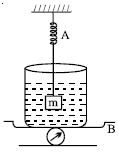
- 1The spring balance $A$ reads $2$ $kg$ with a block $m $ suspended from it. $A$ balance $B$ reads $5$ $kg$ when a beaker with liquid is put on the pan of the balance. The two balances are now so arranged that the hanging mass is inside the liquid in the beaker as shown in the figure in this situation:View Solution
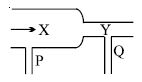
- 2A steady flow of water passes along a horizontal tube from a wide section $X$ to the narrower section $Y$, see figure. Manometers are placed at $P$ and $Q$ at the sections. Which of the statements $A, B, C, D, E$ is most correct?View Solution
- 3A small metal sphere of radius $a$ is falling with a velocity $v$ through a vertical column of a viscous liquid. If the coefficient of viscosity of the liquid is $\eta $ , then the sphere encounters an opposing force ofView Solution
- 4The volume of an air bubble becomes three times as it rises from the bottom of a lake to its surface. Assuming atmospheric pressure to be $75 cm$ of $Hg $ and the density of water to be $1/10$ of the density of mercury, the depth of the lake is ....... $m$View Solution
- 5Toricelli’s barometer used mercury. Pascal duplicated it using French wine of density $984 \;kg m^{-3}$. Determine the height (in $m$) of the wine column for normal atmospheric pressure.View Solution
- 6What is the velocity $v$ of a metallic ball of radius $r$ falling in a tank of liquid at the instant when its acceleration is one-half that of a freely falling body ? (The densities of metal and of liquid are $\rho$ and $\sigma$ respectively, and the viscosity of the liquid is $\eta$).View Solution
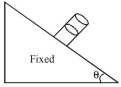
- 7A cylindrical vessel filled with water is released on an inclined surface of angle $\theta$ as shown in figure.The friction coefficient of surface with vessel is $\mu( < \tan \theta)$.Then the contact angle made by the surface of water with the incline will beView Solution
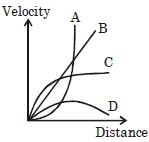
- 8View SolutionA small spherical solid ball is dropped in a viscous liquid. Its journey in the liquid is best described in the figure drawn by:-
- 9Consider the wall of a dam to be straight with height $H$ and length $L$. It holds a lake of water of height $h (h < H)$ on one side. Let the density of water be $\rho_{ w }$. Denote the torque about the axis along the bottom length of the wall by $\tau_1$. Denote also a similar torque due to the water up to height $h / 2$ and wall length $L / 2$ by $\tau_2$. Then $\tau_1 / \tau_2$ (ignore atmospheric pressure) isView Solution
- 10A rectangular block is $10 \,cm \times 10 \,cm \times 15 \,cm$ in size is floating in water with $10 \,cm$ side vertical. If it floats with $15 \,cm$ side vertical, then the level of water will ..........View Solution