MCQ
In a $dc$ motor, induced $e.m.f.$ will be maximum 
  • When motor takes maximum speed
  • B
    When motor starts rotating
  • C
    When speed of motor increases
  • D
    When motor is switched off

Answer

Correct option: A.
When motor takes maximum speed
a
Flux change $\propto $ speed of motor.

Need a full question paper?

Generate a complete, print-ready paper with questions like this in minutes — across 16+ boards, with answer keys.
Start Generating Free

Similar questions

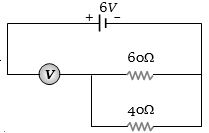
The measurement of voltmeter in the following circuit is ................ $V$
The velocity of light emitted by a source S observed by an observer O, who is at rest with respect to S is c. If the observer moves towards S with velocity v, the velocity of light as observed will be
In free space, an electromagnetic wave of $3 \; GHz$ of $3 \; GHz$ frequency strikes over the edge of an object of size $\frac{\lambda}{100}$, where $\lambda$ is the wavelength of the wave in free space. The phenomenon, which happens there will be .....
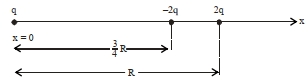
Three point charges $q,-2 q$ and $2 q$ are placed on $x$-axis at a distance $x=0, x=\frac{3}{4} R$ and $x=R$ respectively from origin as shown. If $q =2 \times 10^{-6}\,C$ and $R =2\,cm$, the magnitude of net force experienced by the charge $-2 q$ is .......... $N$
If mean wavelength of light radiated by $100 W$ lamp is $5000 Å$, then number of photons radiated per second are
A plane electromagnetic wave propagating along y-direction can have the following pair of electric field $(\vec{E} )$ and magnetic field $(\overrightarrow{ B })$ components.
At a point 20 cm from the centre of a uniformly charged dielectric sphere of radius 10 cm, the electric field is 100 V/m. The electric field at 3 cm from the centre of the sphere will be
Energy of $1\,g$ uranium is equal to
A Young's double slit experiment uses a monochromatic source. The shape of the interference fringes formed on a screen is
Two balls of same mass and carrying equal charge are hung from a fixed support of length $l$. At electrostatic equilibrium, assuming that angles made by each thread is small, the separation, $x$ between the balls is proportional to