MCQ
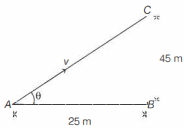
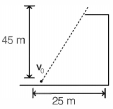
In a circus, a performer throws an apple towards a hoop held at $45 \,m$ height by another performer standing on a high platform (see figure). The thrower aims for the hoop and throws the apple with a speed of $24 \,m / s$. At the exact moment that the thrower releases the apple, the other performer drops the hoop. The hoop falls straight down. At ............ $m$ height above the ground does the apple go through the hoop?
  • A
    $21$
  • $22$
  • C
    $23$
  • D
    $24$

Answer

Correct option: B.
$22$
b
(b)

Given, velocity of projection of apple, $v=24 \,m / s$

Distance between point of projection and hoop is given by

$A C=\sqrt{(25)^2+(45)^2}=\sqrt{2650} m$

So, time taken by the ball to the hoop,

$t=\frac{\sqrt{2650}}{24}$ $s$

The distance covered by hoop is

$s=\frac{1}{2} g t^2=\frac{1}{2} \times 10 \times(\frac{\sqrt{2650}}{{24}})^2$

$=5 \times \frac{2650}{576}=\frac{13250}{576}$

$\therefore$ Height above the ground where apple go through the hoop is

$H=45-\frac{13250}{576}$

$=\frac {12670}{576}\simeq 22 \,m$

Need a full question paper?

Generate a complete, print-ready paper with questions like this in minutes — across 16+ boards, with answer keys.

Start Generating Free

Similar questions

Resistance of a given wire is obtained by measuring the current flowing in it and the voltage difference applied across it. If the percentage errors in the measurement of the current and the voltage difference are $3\%$ each, then error in the value of resistance of the wire is ........ $\%$
A swimmer crosses a river of width $d$ flowing at velocity $v$. While swimming, he heads himself always at an angle of $120^{\circ}$ with the river flow and on reaching the other end he finds a drift of $d / 2$ in the direction of flow of river. The speed of the swimmer with respect to the river is
An elevator in a building can carry a maximum of $10$ persons, with the average mass of each person being $68\; kg$. The mass of the elevator itself is $920\; kg$ and it moves with a constant speed $3\; \mathrm{m} / \mathrm{s}$. The frictional force opposing the motion is $6000 \;\mathrm{N}$. If the elevator is moving up with its full capacity, the power delivered by the motor to the elevator $\left(\mathrm{g}=10 \;\mathrm{m} / \mathrm{s}^{2}\right)$ must be at least .............. $\mathrm{W}$
If a ladder weighing $250\,N$ is placed against a smooth vertical wall having coefficient of friction between it and floor is $0.3$, then what is the maximum force of friction available at the point of contact between the ladder and the floor ........ $N$
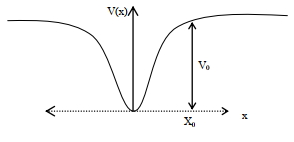
When a particle of mass $m$ moves on the $x$-axis in a potential of the form $V(x)=\mathrm{kx}^2$ it performs simple harmonic motion. The corresponding time period is proportional to $\sqrt{\frac{\mathrm{m}}{\mathrm{k}}}$, as can be seen easily using dimensional analysis. However, the motion of a particle can be periodic even when its potential energy increases on both sides of $\mathrm{x}=0$ in a way different from $\mathrm{kx}^2$ and its total energy is such that the particle does not escape to infinity. Consider a particle of mass $\mathrm{m}$ moving on the $x$-axis. Its potential energy is $V(x)=\alpha x^4(\alpha>0)$ for $|x|$ near the origin and becomes a constant equal to $\mathrm{V}_0$ for $|x| \geq X_0$ (see figure). $Image$

$1.$ If the total energy of the particle is $E$, it will perform periodic motion only if

$(A)$ $E$ $<0$ $(B)$ $E$ $>0$ $(C)$ $\mathrm{V}_0 > \mathrm{E}>0$ $(D)$ $E > V_0$

$2.$ For periodic motion of small amplitude $\mathrm{A}$, the time period $\mathrm{T}$ of this particle is proportional to

$(A)$ $\mathrm{A} \sqrt{\frac{\mathrm{m}}{\alpha}}$ $(B)$ $\frac{1}{\mathrm{~A}} \sqrt{\frac{\mathrm{m}}{\alpha}}$ $(C)$ $\mathrm{A} \sqrt{\frac{\alpha}{\mathrm{m}}}$ $(D)$ $\mathrm{A} \sqrt{\frac{\alpha}{\mathrm{m}}}$

$3.$ The acceleration of this particle for $|\mathrm{x}|>\mathrm{X}_0$ is

$(A)$ proportional to $\mathrm{V}_0$

$(B)$ proportional to $\frac{\mathrm{V}_0}{\mathrm{mX}_0}$

$(C)$ proportional to $\sqrt{\frac{\mathrm{V}_0}{\mathrm{mX}_0}}$

$(D)$ zero

Give the answer qustion $1,2$ and $3.$

According to the kinetic theory of gases, total energy of a gas is equal to
A particle moves in a region having a uniform magnetic field and a parallel, uniform electric field. At some instant, the velocity of the particle is perpendicular to the field direction. The path of the particle will be:
  1. A straight line.
  2. A circle.
  3. A helix with uniform pitch.
  4. A helix with nonuniform pitch.
The transverse displacement of a string (clamped at its both ends) is given by $\text{y}(\text{x, t})=0.06\sin(1\pi\text{x/ 3})\cos(120\pi\text{t}).$
All the points on the string between two consecutive nodes vibrate with
  1. Same frequency.
  2. Same phase.
  3. Same energy.
  4. Different amplitude.
If amplitude of waves at distance $r$ from a point source is $A$, the amplitude at a distance $2r$ will be
A mixture of ideal gases has $2$ moles of He, $4$ moles of oxygen and $1$ mole of ozone at absolute temperature $T$. The internal energy of mixture is ............. $RT$