Question
In a double slit interference experiment, the separation between the slits is 1.0mm, the wavelength of light used is 5.0 × 10⁻⁷m and the distance of the screen from the slits is 1.0m.
  1. Find the distance of the centre of the first minimum from the centre of the central maximum.
  2. How many bright fringes are formed in one centimeter width on the screen?

Answer

Given that, d = 1mm = 10-3m, D = 1m.
So, fringe with $=\frac{\text{D}\lambda}{\text{d}}=0.5\text{mm}.$
  1. So, distance of centre of first minimum from centre of central maximum $=\frac{0.5}{2}\text{mm}=0.25\text{mm}$
  2. No. of fringes $\frac{10}{0.5}=20.$

Need a full question paper?

Generate a complete, print-ready paper with questions like this in minutes — across 16+ boards, with answer keys.

Start Generating Free

Similar questions

Which physical quantities are conserved in natural and artificial radioactivity?
A short bar magnet placed with its axis at 30º with a uniform external magnetic field of 0.25 T experiences a torque of magnitude equal to 4.5 × 10–2 J. What is the magnitude of magnetic moment of the magnet?
A solenoid of length $0.5 m$ has a radius of $1 cm$ and is made up of 500 turns. It carries a current of $5 A$. What is the magnitude of the magnetic field inside the solenoid?
A beam of electrons enters crossed region of electric field of intensity $E$ and magnetic field of intensity B. For what speed of electrons, the electron beam will remain unaffected?
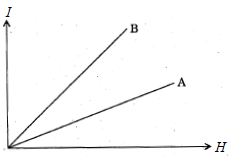
The following figure shows the variation of intensity of magnetisation versus the applied magnetic field intensity, H, for two magnetic materials A and B:

  1. Identify the materials A and B.
  2. Why does the material B, have a larger susceptibility than A, for a given field at constant temperature?
Find the maximum angular speed of the electron of a hydrogen atom in a stationary orbit.
An $\alpha$–particle and a proton are moving in the plane of paper in a region where there is a uniform magnetic field directed normal to the plane of the paper. If the particles have equal linear momenta, what would be the ratio of the radii of their trajectories in the field?
Explain electric field produced by the point electric charge.
The magnetic properties of the different materials A, B and C are shown in the following table:
Material Permeability Susceptibility Temperature dependence of susceptibility.
A Low positive Small but negative Independent of temperature
B High Very high 1 Susceptibility decreases with temperature
C Greater than 1  Small but positive Decreases with temperature
Which of the above three materials should be used for making an electromagnet and why?
Explain network, junction point (branch point) and loop.