Question
In a ferromagnetic material, below the curie temperature, a domain is defined as:

Answer

conceptual

Need a full question paper?

Generate a complete, print-ready paper with questions like this in minutes — across 16+ boards, with answer keys.

Start Generating Free

Similar questions

A heavy small-sized sphere is suspended by a string of length $l$. The sphere rotates uniformly in a horizontal circle with the string making an angle $\theta $ with the vertical. Then the time period of this conical pendulum is
An iron rod of susceptibility $599$ is subjected to a magnetising field of $1200\, Am ^{-1}$. The permeability of the material of the rod is 

$\left(\mu_{0}=4 \pi \times 10^{-7}\, T\, m\, A ^{-1}\right)$
The acceleration due to gravity is found upto an accuracy of $4 \,\%$ on a planet. The energy supplied to a simple pendulum to known mass ' ${m}$ ' to undertake oscillations of time period $T$ is being estimated. If time period is measured to an accuracy of $3\, \%$, the accuracy to which ${E}$ is known as $..........\,\%$
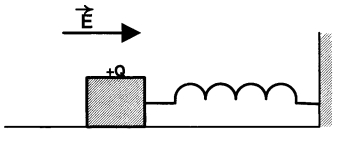
A wooden block performs $SHM$ on a frictionless surface with frequency, $v_0$. The block carries a charge $+Q$ on its surface. If now a uniform electric field $\vec{E}$ is switched-on as shown, then the $SHM$ of the block will be
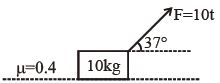
A force acts on a block as shown in figure. Find time when block loses contact with surface.
A raindrop with radius $R=0.2\, {mm}$ fells from a cloud at a height $h=2000\, {m}$ above the ground. Assume that the drop is spherical throughout its fall and the force of buoyance may be neglected, then the terminal speed attainde by the raindrop is : (In ${ms}^{-1}$)

[Density of water $f_{{w}}=1000\;{kg} {m}^{-3}$ and density of air $f_{{a}}=1.2\; {kg} {m}^{-3}, {g}=10 \;{m} / {s}^{2}$ Coefficient of viscosity of air $=18 \times 10^{-5} \;{Nsm}^{-2}$ ]
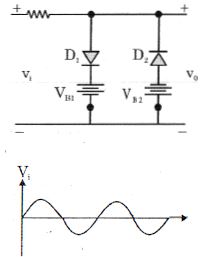
Consider the following circuit the waveform given in input is If ${V_{{B_1}}}$ , and ${V_{{B_2}}}$  , are less than peak value of input than output will look like
A point electric dipole placed at the origin has a potential given by $V(r, \theta)=\frac{p \cos \theta}{4 \pi \varepsilon_0 r^2}$, where $\theta$ is the angle made by the position vector with the direction of the dipole. Then,
Which of the following waves have the maximum wavelength
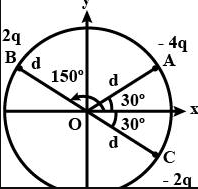
Three charged particle $A, B$ and $C$ with charges $-4 q,  2 q$ and $-2 q$ are present on the circumference of a circle of radius $d$. the charged particles $A, C$ and centre $O$ of the circle formed an equilateral triangle as shown in figure. Electric field at $O$ along $x-$direction is