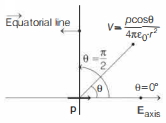
A point electric dipole placed at the origin has a potential given by $V(r, \theta)=\frac{p \cos \theta}{4 \pi \varepsilon_0 r^2}$, where $\theta$ is the angle made by the position vector with the direction of the dipole. Then,
KVPY 2009, Medium


Download our appand get started for free
Experience the future of education. Simply download our apps or reach out to us for more information. Let's shape the future of learning together!No signup needed.*
Similar Questions
- 1Two capacitors of capacities $2 {C}$ and ${C}$ are joined in parallel and charged up to potential ${V}$. The battery is removed and the capacitor of capacity $C$ is filled completely with a medium of dielectric constant ${K}$. The potential difference across the capacitors will now beView Solution
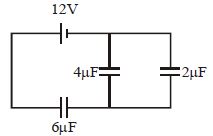
- 2The charge deposited on $4\,\mu F$ capacitor in the circuit isView Solution
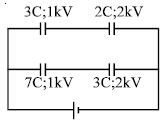
- 3The diagram shows four capacitors with capacitances and break down voltages as mentioned. What should be the maximum value of the external emf source such that no capacitor breaks down ? .......$kV$View Solution
- 4A charge $Q$ is distributed over three concentric spherical shell of radii $a, b, c (a < b < c)$ such that their surface charge densities are equal to one another. The total potential at a point at distance $r$ from their common centre, where $r < a$, would beView Solution
- 5A non-conducting ring of radius $0.5\,m$ carries a total charge of $1.11 \times {10^{ - 10}}\,C$ distributed non-uniformly on its circumference producing an electric field $\vec E$ everywhere in space. The value of the line integral $\int_{l = \infty }^{l = 0} {\, - \overrightarrow E .\overrightarrow {dl} } \,(l = 0$ being centre of the ring) in volt isView Solution
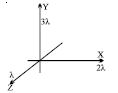
- 6The diagram shows three infinitely long uniform line charges placed on the $X, Y $ and $Z$ axis. The work done in moving a unit positive charge from $(1, 1, 1) $ to $(0, 1, 1) $ is equal toView Solution
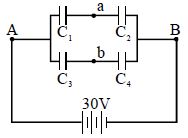
- 7Four capacitors with capacitances $C_1 = 1\,\mu F, C_2 = 1.5\,\mu F, C_3 = 2.5\,\mu F$ and $C_4 = 0.5\,\mu F$ are connected as shown and are connected to a $30\, volt$ source. The potential difference between points $a$ and $b$ is.....$V$View Solution
- 8Four metal conductors having different shapesView Solution
$1.$ A sphere $2.$ Cylindrical
$3.$ Pear $4.$ Lightning conductor
are mounted on insulating stands and charged. The one which is best suited to retain the charges for a longer time is
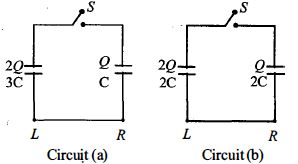
- 9Two circuits $(a)$ and $(b)$ have charged capacitors of capacitance $C, 2C$ and $3C$ with open switches. Charges on each of the capacitor are as shown in the figures. On closing the switchesView Solution
- 10If potential (in volts) in a region is expressed as $V (x,y,z) =6xy-y+2yz $ the electric field (in $N/C$) at point $(1, 1, 0)$ isView Solution