Question
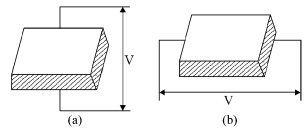
In a given figure, a rectangular object is shown. Its length is I, breadth is 0.5 I and thickness 0.25 I . To measure its resistance, potential difference $V$ is applied in two ways [figure (a) and (b)]. In which arrangement, the resistance of the substance will be more?
Image

Answer

If resistance in both states is $R_1$ and $R_2$
By definition of resistance,$R =\rho \frac{l}{A}$
$R _1=\frac{\rho(0.25 l)}{(l)(0.5 l)}=\frac{\rho}{2 l}$
and $R _2=\frac{(\rho)(l)}{(0.5 l)(0.25 l)}=\frac{8 \rho}{l}$
i.e. $\quad R _2> R _1$
Although the resistance of substance does not depend on potential difference and current but depends on the area of the cross section from which current enters.

Need a full question paper?

Generate a complete, print-ready paper with questions like this in minutes — across 16+ boards, with answer keys.

Start Generating Free

Similar questions

A 44 mH inductor is connected to $220 V, 50 Hz$ ac supply. Determine the mH value of the current in the circuit.
When a boron nucleus $\big(\text{ }^{10}_5\text{B}\big)$ is bombarded by a neutron, an $\alpha$-particle is emitted. Which nucleus will be formed as a result?
Calculate the mass of an $\alpha$-particle. Its binding energy is 28.2MeV.
Explain : Electrostatic shielding.
When a nucleus at rest emits a beta particle, it is found that the velocities of the recoiling nucleus and the beta particle are not along the same straight line. How can this be possible in view of the principle of conservation of momentum?
Calculate the momentum of a photon of light of wavelength 500nm.
Explain resonance for $L-C-R$ series $A C$ circuit. Obtain the equation of resonance frequency and explain resonance curve.
The linewidth of a bright fringe is sometimes defined as the separation between the points on the two sides of the central line where the intensity falls to half the maximum. Find the linewidth of a bright fringe in a Young's double slit experiment in terms of $\lambda$, d and D where the symbols have their usual meanings.
As the wavelength is increased from violet to red, the luminosity:
  1. Continuously increases.
  2. Continuously decreases.
  3. Increases then decreases.
  4. Decreases then increases.
If the nucleons of a nucleus are separated far apart from each other, the sum of masses of all these nucleons is larger than the mass of the nucleus. Where does this mass difference come from?