In a gultar, two strings $A$ and $B$ made of same materlal are slightly out of tune and produce beats of frequency $6\, Hz$. When tension in $B$ is slightly decreased, the beat frequency increases to $7 \,Hz$. If the frequency of $A$ is $530\, Hz ,$ the orlginal frequency of $B$ will be $.........Hz$
NEET 2020, Medium
Download our app for free and get started
Guitar string i.e. string is fixed from both ends
Frequency $\propto \sqrt{\text { Tension }}$
If tension in $B$ slightly decrease then frequency of $B$ decrease.
If $B$ is $536 Hz$, as the frequency decreases, beats with A also decreases.
If $B$ is $524 Hz$, as the frequency decreases, beats with $A$ increases.
$\therefore$ Original frequency of $B$ will be $524 Hz$.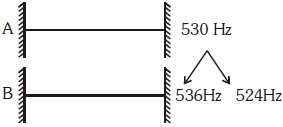

Download our appand get started for free
Experience the future of education. Simply download our apps or reach out to us for more information. Let's shape the future of learning together!No signup needed.*
Similar Questions
- 1A stationary wave is represented by $y=A \sin (100 t) \cos (0.01 x)$, where $y$ and $A$ are in millimetres, $t$ is in second and $x$ is in metre. The velocity of the constituent wave is ........... $m / s$View Solution
- 2A train moving towards a hill at a speed of $72\ km/hr$ sounds a whistle of frequency $500\ Hz$ . A wind is blowing from the hill at a speed of $36\ km/hr$ . If the speed of sound in air is $340\ m/s$ , the frequency heard by a man on the hill (nearly) is ... $Hz$View Solution
- 3View SolutionWhich of the following equations represents a travelling wave ?
- 4Fundamental frequency of pipe is $100 Hz$ and other two frequencies are $300 Hz$ and $500 Hz$ thenView Solution
- 5Speed of a transverse wave on a straight wire (mass $6.0\; \mathrm{g}$, length $60\; \mathrm{cm}$ and area of cross-section $1.0\; \mathrm{mm}^{2}$ ) is $90\; \mathrm{ms}^{-1} .$ If the Young's modulus of wire is $16 \times 10^{11}\; \mathrm{Nm}^{-2},$ the extension of wire over its natural length isView Solution
- 6In a resonance tube experiment when the tube is filled with water up to height of $17.0\, cm$ from bottom, it resonates with a given tuning fork. When the water level is raised the next resonance with the same tuning fork occurs at a height of $24.5\, cm$. If the velocity of sound in air is $330\, m / s ,$ the tuning fork frequency is$......Hz$View Solution
- 7An earthquake generates both transverse $(S)$ and longitudinal $(P)$ sound waves in the earth. The speed of $S$ waves is about $4.5\,km/s$ and that of $P$ waves is about $8.0\, km/s$. A seismograph records $P$ and $S$ waves from an earthquake. The first $P$ wave arrives $4.0 \,min$ before the first $S$ wave. The epicenter of the earthquake is located at a distance about ..... $km$View Solution
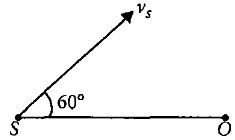
- 8A source of sound $S$ emitting waves of frequency $100\,\, Hz$ and an observer $O$ are ocated at some distance from each other. The source is moving with a speed of $19 .4\,\, m s^{-1}$ at an angle of $60^o $ with the source observer line as shown in the figure. The observer is at rest. The apparent frequency observed by the observer .... $Hz$ (velocity of sound in air $330 \,\, m s^{-1}$), isView Solution
- 9View SolutionWhen we hear a sound, we can identify its source from
- 10Select the correct statement about the reflection and refraction of a wave at the interface between the medium $1$ and $2$ theView Solution