MCQ
In a harmonium the intermediate notes between a note and its octave form
  • A
    An arithmetic progression
  • A geometric progression
  • C
    A harmonic progression
  • D
    An exponential progression

Answer

Correct option: B.
A geometric progression
(b)

Need a full question paper?

Generate a complete, print-ready paper with questions like this in minutes — across 16+ boards, with answer keys.
Start Generating Free

Similar questions

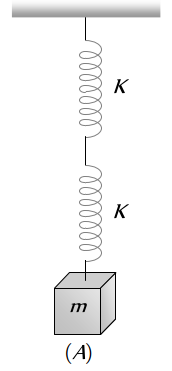
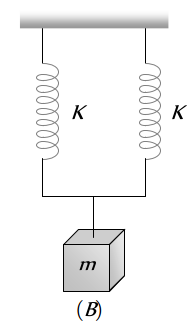
Two identical spring of constant $K$ are connected in series and parallel as shown in figure. A mass $m$ is suspended from them. The ratio of their frequencies of vertical oscillations will be

Image

Image

A thermo couple is formed by two metals $X$ and $Y$ metal $X$ comes earlier to $Y$ in Seebeck series. If temperature of hot junction increases beyond the temperature of inversion. Then direction of current in thermocouple will so
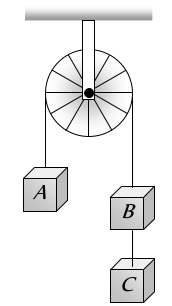
Three equal weights $A, B$ and $C$ of mass $2 kg$ each are hanging on a string passing over a fixed frictionless pulley as shown in the figure The tension in the string connecting weights $B$ and $C$ is
The length of a wire is $1.0 m$ and the area of cross-section is $1.0 \times 10^{-2} cm ^2$. If the work done for increase in length by $0.2 cm$ is 0.4 joule, then Young's modulus of the material of the wire is
A bulb of $100$ watt is hanging at a height of one meter above the centre of a circular table of diameter $4 \mathrm{~m}$. If the intensity at a point on its rim is $I_0$, then the intensity at the centre of the table will be
The displacement $x$ (in metre) of a particle in, simple harmonic motion is related to time $t$ (in seconds) as$x=0.01 \cos \left(\pi t+\frac{\pi}{4}\right)$ The frequency of the motion will be
Which of the following statements are true regarding Bohr's model of hydrogen atom$(1)$ Orbiting speed of electron decreases as it shifts to discrete orbits away from the nucleus$(11)$ Radii of allowed orbits of electron are proportional to the principal quantum number$(111)$ Frequency with which electrons orbits around the nucleus in discrete orbits is inversely proportional to the principal quantum number $(IV)$ Binding force with which the electron is bound to the nucleus increases as it shifts to outer orbits Select correct answer using the codes given below Codes :
A gas expands under constant pressure $P$ from volume $V_1$ to $V_2$. The work done by the gas is
We have two (narrow) capillary tubes $T$ and $T$. Their lengths are $l$ and $I$ and radii of cross-section are $r$ and $r$ respectively. The rate of flow of water under a pressure difference $P$ through tube $T$ is $8 cm / sec$. If $I=2 l$ and $r=r$, what will be the rate of flow when the two tubes are connected in series and pressure difference across the combination is same as before $(=P)$
A particle executing simple harmonic motion along $y-$ axis has its motion described by the equation $y=A \sin (\omega t)+B$. The amplitude of the simple harmonic motion is