Question
In a head-on collision between two particles, is it necessary that the particles will acquire a common velocity at least for one instant?

Answer

It is not necessary that in a head on collision the particles would acquire same initial velocity it is possible in elastic collision but it is not necessary.

Need a full question paper?

Generate a complete, print-ready paper with questions like this in minutes — across 16+ boards, with answer keys.
Start Generating Free

Similar questions

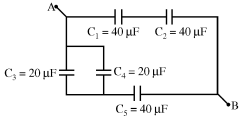
If five capacitors $C_1, C_2, C_3, C_4, C_5$ are connected in an electric circuit as shown in the figure, then calculate the equivalent capacitance of this network between point $A$ and point $B$.
Image
Two identical bars, one of paramagnetic material and other of diamagnetic material are kept in a uniform external magnetic field parallel to it. Draw diagrammatically the modifications in the magnetic field pattern in each case.
Draw 3 equipotential surfaces corresponding to a field that uniformly increases in magnitude but remains constant along Z-direction. How are these surfaces different from that of a constant electric field along Z-direction?
a. It is not advisable to use a galvanometer as such to measure current directly. Why?
b. Why should the value of resistance connected in parallel to a galvanometer be low?
c. Is the reading shown by an ammeter in a circuit less than or more than the actual value of current flowing in the circuit? Why?
An inductor is connected to a battery through a switch. Explain why the emf induced in the inductor is much larger when the switch is opened as compared to the emf induced when the switch is closed.
State the Oersted's observation.
A block of mass 0.2kg is suspended from the ceiling by a light string. A second block of mass 0.3kg is suspended from the first block through another string. Find the tensions in the two strings. Take $g = 10m/s^2$.
Write down the definition of energy density and derive the equation of energy density of electric field.
Explain the classification of material in terms of resistivity.
Equipotential surfaces are 5 cm apart from each other. How much work will be required to move a 500 µC charge between distant points?