In a hollow spherical shell potential $(V)$ changes with respect to distance $(r)$ from centre
Easy
Download our app for free and get started
(b) ${V_{inside}} = \frac{Q}{{4\pi {\varepsilon _0}R}}$ for $r \le R$ ....$(i)$
and ${V_{out}} = \frac{Q}{{4\pi {\varepsilon _0}r}}$ for $r \ge R$ ....$(ii)$
i.e. potential inside the hollow spherical shell is constant and outside varies according to $V \propto \frac{1}{r}$.
and ${V_{out}} = \frac{Q}{{4\pi {\varepsilon _0}r}}$ for $r \ge R$ ....$(ii)$
i.e. potential inside the hollow spherical shell is constant and outside varies according to $V \propto \frac{1}{r}$.

Download our appand get started for free
Experience the future of education. Simply download our apps or reach out to us for more information. Let's shape the future of learning together!No signup needed.*
Similar Questions
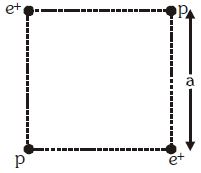
- 1Two positrons $(e^+)$ and two protons $(p)$ are kept on four corners of a square of side $a$ as shown in figure. The mass of proton is much larger than the mass of positron. Let $q$ denotes the charge on the proton as well as the positron then the kinetic energies of one of the positrons and one of the protons respectively after a very long time will be-View Solution
- 2In a parallel plate condenser, the radius of each circular plate is $12\,cm$ and the distance between the plates is $5\,mm$. There is a glass slab of $3\,mm$ thick and of radius $12\,cm$ with dielectric constant $6$ between its plates. The capacity of the condenser will beView Solution
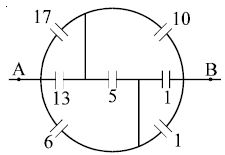
- 3Find equivalent capacitance across $AB$.....$ \mu F$ (all capacitances in $\mu F$)View Solution
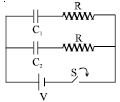
- 4In the circuit shown in figure $C_1=2C_2$. Switch $S$ is closed at time $t=0$. Let $i_1$ and $i_2$ be the currents flowing through $C_1$ and $C_2$ at any time $t$, then the ratio $i_1/ i_2$View Solution
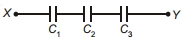
- 5In the circuit below $C_1=20 \,\mu F , C_2=40 \,\mu F$ and $C_3=50 \,\mu F$. If no capacitor can sustain more than $50 \,V$, then maximum potential difference between $X$ and $Y$ is .......... $V$View Solution
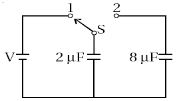
- 6A capacitor of $2\,\, \mu F$ is charged as shown in the diagram. When the switch $S$ is turned to position $2,$ the percentage of its stored energy dissipated is ......$\%$View Solution
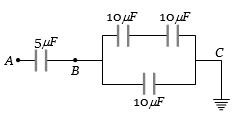
- 7In the given circuit if point $C$ is connected to the earth and a potential of $ + \,2000\,V$ is given to the point $A$, the potential at $B$ is.....$V$View Solution
- 8An infinite number of charges each equal to $0.2\,\mu C$ are arranged in a line at distances $1\,m, 2\,m, 4\,m, 8\,m......$ from a fixed point. The potential at fixed point is ......$kV$View Solution
- 9A parallel plate capacitor of capacitance $C$ has spacing $d$ between two plates having area $A$. The region between the plates is filled with $N$ dielectric layers, parallel to its plates, each with thickness $\delta=\frac{ d }{ N }$. The dielectric constant of the $m ^{\text {th }}$ layer is $K _{ m }= K \left(1+\frac{ m }{ N }\right)$. For a very large $N \left(>10^3\right)$, the capacitance $C$ is $\alpha\left(\frac{ K \varepsilon_0 A }{ d \;ln 2}\right)$. The value of $\alpha$ will be. . . . . . . .View Solution
[ $\epsilon_0$ is the permittivity of free space]
- 10With the rise in temperature, the dielectric constant $K$ of a liquidView Solution