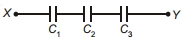
In the circuit below $C_1=20 \,\mu F , C_2=40 \,\mu F$ and $C_3=50 \,\mu F$. If no capacitor can sustain more than $50 \,V$, then maximum potential difference between $X$ and $Y$ is .......... $V$
Medium


Download our appand get started for free
Experience the future of education. Simply download our apps or reach out to us for more information. Let's shape the future of learning together!No signup needed.*
Similar Questions
- 1In space of horizontal $EF$ ($E = (mg)/q$) exist as shown in figure and a mass $m$ attached at the end of a light rod. If mass $m$ is released from the position shown in figure find the angular velocity of the rod when it passes through the bottom most positionView Solution

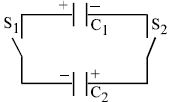
- 2Two capacitors $C_1 = 4\ \mu F$ and $C_2 = 2\ \mu F$ are charged to same potential $ V = 500\ Volt$, but with opposite polarity as shown in the figure. The switches $S_1$ and $S_2$ are closed.View Solution
- 3If the electric potential of the inner metal sphere is $10$ $ volt$ $\&$ that of the outer shell is $5$ $volt$, then the potential at the centre will be ......$volt$View Solution

- 4A resistance $R$ and a capacitance $C$ are connected in series to a battery of negligible internal resistance through a key. The key is closed at $t = 0$. If after $t\, sec$ the voltage across the capacitance was seven times the voltage across $R$, the value of $t$ isView Solution
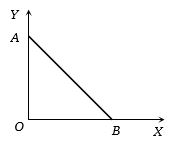
- 5As per this diagram a point charge $ + q$ is placed at the origin $O$. Work done in taking another point charge $ - Q$ from the point $A$ [co-ordinates $(0,\,a)$] to another point $B$ [co-ordinates $(a, 0)$] along the straight path $AB$ isView Solution
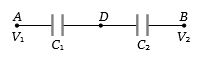
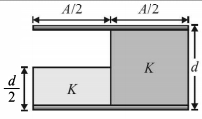
- 6A parallel plate capacitor of area ' $A$ ' plate separation ' $d$ ' is filled with two dielectrics as shown. What is the capacitance of the arrangement?View Solution
- 7How will the voltage $(V)$ between the two plates of a parallel plate capacitor depend on the distance $(d)$ between the plates, if the charge on the capacitor remains the same?View Solution
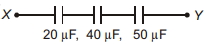
- 8In the figure, three capacitors each of capacitance $6\,pF$ are connected in series. The total capacitance of the combination will beView Solution
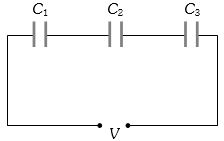
- 9A sphere of radius $1\,cm$ has potential of $8000\,V$, then energy density near its surface will beView Solution
- 10Two condensers ${C_1}$and ${C_2}$ in a circuit are joined as shown in figure. The potential of point $A$ is ${V_1}$ and that of $B$ is ${V_2}$. The potential of point $D$ will beView Solution