Question
In a junction diode, the holes are due to

Answer

(d) In a junction diode, the free electrons combine with a hole and gets converted into a valence electron. Now the thermal energy breaks this electron-hole pair in the depletion layer, the electron drifts to the $n-type$ region leaving behind the hole which drifts to the $p-type$ region.

Need a full question paper?

Generate a complete, print-ready paper with questions like this in minutes — across 16+ boards, with answer keys.
Start Generating Free

Similar questions

Tollen's reagent is
A candle flame of $3\, cm$ is placed at $3\, m$ from a wall. A concave mirror is kept at distance $x$ from the wall in such a way that image of the flame on the wall is $9\, cm$. Then $x$ is......$cm$
The mean life of a radioactive sample are $30\,year$ and $60\,year$ for $\alpha -$ emission and $\beta -$ emission respectively. If the sample decays both by $\alpha -$ emission and $\beta -$ emission simultaneously, then the time after which, only one-fourth of the sample remain is approximately ............ $years$
A cell of e.m.f. $E$ is connected with an external resistance $R$, then p.d. across cell is $V$. The internal resistance of cell will be
The plates of a parallel plate capacitor are charged up to $100 \,volt$ . A $2 \,mm$ thick plate is  inserted between the plates, then to maintain the same potential difference, the distance  between the capacitor plates is increased by $1.6\, mm$. The dielectric constant of the plate  is :-
A cannon is adjusted at an angle to obtain a maximum range of 20 m with initial velocity 20 m/s. Minimum range of fire is obtained when the cannon is fired with an angle of $30^{\circ}$ with initial velocity 15 m/s. If bullets are fired from both the angles, the difference in the height attained will be
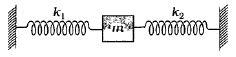
Two springs, of force constants $k_1$ and $k_2$ are connected to a mass $m$ as shown. The frequency of oscillation of the mass is $f$ If both $k_1$ and $k_2$ are made four times their original values, the frequency of oscillation becomes
A nucleus of masss $M$ emits $\gamma$-ray photon of frequency $'v'.$ The loss of internal energy by the nucleus is:
If ${\lambda _{{\rm{max}}}}$ is $6563 Å$, then wave length of second line for Balmer series will be
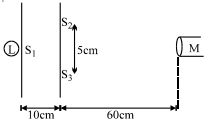
$A$ student is asked to measure the wavelength of monochromatic light. He sets up the apparatus sketched below. $S_1, S_2, S_3$ are narrow parallel slits, $L$ is a sodium lamp and $M$ is a microscope eyepiece. The student fails to observe interference fringes. Your first advice to him will be