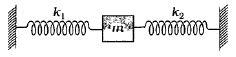
Two springs, of force constants $k_1$ and $k_2$ are connected to a mass $m$ as shown. The frequency of oscillation of the mass is $f$ If both $k_1$ and $k_2$ are made four times their original values, the frequency of oscillation becomes
AIEEE 2007, Medium
Download our app for free and get started
The two springs are in parallel.
$f=\frac{1}{2 \pi} \sqrt{\frac{K_{1}+K_{2}}{m}}$ $...(i)$
$f^{\prime}=\frac{1}{2 \pi} \sqrt{\frac{4 K_{1}+4 K_{2}}{m}}$
$=\frac{1}{2 \pi} \sqrt{\frac{4\left(K_{1}+4 K_{2}\right)}{m}}=2\left(\frac{1}{2 \pi} \sqrt{\frac{K_{1}+K_{2}}{m}}\right)$
$=2 f \quad$ from eqn. $(i)$
$f=\frac{1}{2 \pi} \sqrt{\frac{K_{1}+K_{2}}{m}}$ $...(i)$
$f^{\prime}=\frac{1}{2 \pi} \sqrt{\frac{4 K_{1}+4 K_{2}}{m}}$
$=\frac{1}{2 \pi} \sqrt{\frac{4\left(K_{1}+4 K_{2}\right)}{m}}=2\left(\frac{1}{2 \pi} \sqrt{\frac{K_{1}+K_{2}}{m}}\right)$
$=2 f \quad$ from eqn. $(i)$

Download our appand get started for free
Experience the future of education. Simply download our apps or reach out to us for more information. Let's shape the future of learning together!No signup needed.*
Similar Questions
- 1For a particle executing $S.H.M.,\, x =$ displacement from equilibrium position, $v =$ velocity at any instant and $a =$ acceleration at any instant, thenView Solution
- 2A $1 \,kg$ block attached to a spring vibrates with a frequency of $1\, Hz$ on a frictionless horizontal table. Two springs identical to the original spring are attached in parallel to an $8\, kg$ block placed on the same table. So, the frequency of vibration of the $8\, kg$ block is ..... $Hz$View Solution
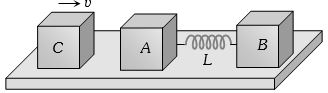
- 3Two blocks $A$ and $B$ each of mass m are connected by a massless spring of natural length L and spring constant $K$. The blocks are initially resting on a smooth horizontal floor with the spring at its natural length as shown in figure. A third identical block $C$ also of mass $m$ moves on the floor with a speed $v$ along the line joining $A$ and $B$ and collides with $A$. ThenView Solution
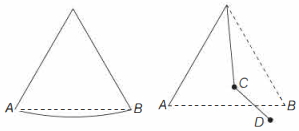
- 4A simple pendulum oscillates freely between points $A$ and $B$. We now put a peg (nail) at the point $C$ as shown in above figure. As the pendulum moves from $A$ to the right, the string will bend at $C$ and the pendulum will go to its extreme point $D$. Ignoring friction, the point $D$View Solution
- 5View SolutionA tunnel has been dug through the centre of the earth and a ball is released in it. It will reach the other end of the tunnel after
- 6View SolutionTo make the frequency double of a spring oscillator, we have to
- 7$x$ and $y$ displacements of a particle are given as $x(t) = a\,sin\,\omega t$ and $y(t) = a\,sin\,2\omega t.$ Its trajectory will look likeView Solution
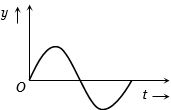
- 8The displacement time graph of a particle executing $S.H.M.$ is as shown in the figureThe corresponding force-time graph of the particle isView Solution
- 9If a spring extends by $x$ on loading, then energy stored by the spring is (if $T$ is the tension in the spring and $K$ is the spring constant)View Solution
- 10What is the maximum acceleration of the particle doing the $SHM$ $y = 2\sin \left[ {\frac{{\pi t}}{2} + \phi } \right]$ where $2$ is in $cm$View Solution