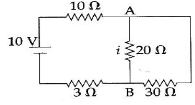
In a metallic conductor, under the effect of applied electric field, the free electrons of the conductor
JEE MAIN 2023, Medium


Download our appand get started for free
Experience the future of education. Simply download our apps or reach out to us for more information. Let's shape the future of learning together!No signup needed.*
Similar Questions
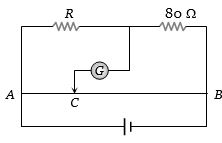
- 1$AB$ is a wire of uniform resistance. The galvanometer $G$ shows no current when the length $AC = 20\,cm$ and $CB = 80\, cm$. The resistance $R$ is equal to .............. $\Omega $View Solution
- 2In the box shown current $i$ enters at $H$ and leaves at $C$. If $i_{AB} = \frac{{\text{i}}}{6}$ , $i_{DC} = \frac{{\text{2i}}}{3}$ ,$i_{HA} = \frac{{\text{i}}}{2} , i_{GF} = \frac{{\text{i}}}{6} , i_{HE} = \frac{{\text{i}}}{6}$ , choose the branch in which current is zeroView Solution

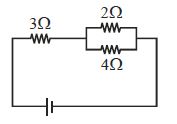
- 3If power in $3\,\Omega $ is $27\,W$ then what is the power in $2\,\Omega $ ................ $\mathrm{W}$View Solution
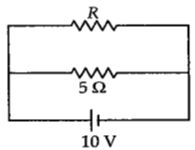
- 4he power dissipated in the circuit shown in the figure is $30\,W$. The value of $R$ is ............. $\Omega$View Solution
- 5Two equal resistances when connected in series to a battery, consume electric power of $60\,W.$ If these resistances are now connected in parallel combination to the same battery, the electric power consumed will be .............. $W$View Solution
- 6When current supplied by a cell to a circuit is $0.3 \,A$, its terminal potential difference is $0.9 \,V$. When the current supplied becomes $0.25 \,A$, its terminal potential difference becomes $1.0 \,V$. The internal resistance of the cell is ............ $\Omega$View Solution
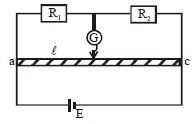
- 7Fig. shows rough sketch of meter bridge. $(G)$ deflects zero at length $\ell \, cm$. Now $R_1$ and $R_2$ are interchanged then balancing length increases by $25\, cm$. Find $R_1/R_2$View Solution
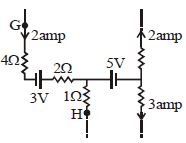
- 8In the part of a circuit shown in the figure, the potential difference $(V_G -V_H)$ between points $G$ and $H$ will be ............... $V$View Solution
- 9When three identical bulbs of $60 \;W, 200\;V$ rating are connected in series to a $200 \;V$ supply, the power drawn by them will be ....... $Watt$View Solution
- 10In the electrical circuit shown in the figure, the current $i$ through the side $AB$ isView Solution