The length of a wire of a potentiometer is $100\, cm$, and the $emf$ of its standard cell is $E\,volt$. It is employed to measure the $e.m.f$ of a battery whose internal resistance is $0.5 \,\Omega$. If the balance point is obtained at $l = 30\, cm$ from the positive end, the $e.m.f.$ of the battery is
where $i$ is the current in the potentiometer
AIEEE 2003, Medium


Download our appand get started for free
Experience the future of education. Simply download our apps or reach out to us for more information. Let's shape the future of learning together!No signup needed.*
Similar Questions
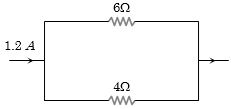
- 1In the figure given below, the current passing through $6\,\Omega $ resistor is ........... $ampere$View Solution
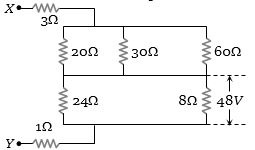
- 2The potential difference across $8\, ohm$ resistance is $48\, volt$ as shown in the figure. The value of potential difference across $X$ and $Y$ points will be ............. $volt$View Solution
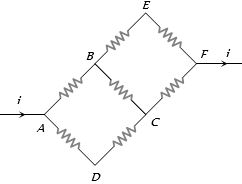
- 3In the adjoining circuit diagram each resistance is of $10$ $\Omega$. The current in the arm $AD$ will beView Solution
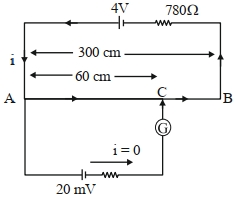
- 4A potentiometer wire of length $300\,cm$ is connected in series with a resistance $780\,\Omega$ and a standard cell of emf $4\,V$. A constant current flows through potentiometer wire. The length of the null point for cell of emf $20\,mV$ is found to be $60\,cm$. The resistance of the potentiometer wire is$...\Omega$View Solution
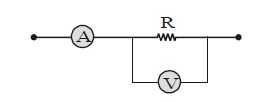
- 5In the circuit shown the readings of ammeter and voltmeter are $4\,\, A$ and $20\,\, V$ respectively. The meters are non ideal, then $R$ isView Solution
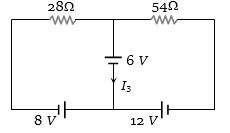
- 6Consider the circuit shown in the figure. The current ${I_3}$ is equal toView Solution
- 7View SolutionResistance of one carbon filament and one tungsten lamp are measured individually when the lamp are lit and compared with their respective resistances when cold. Which one of the following statements will be true
- 8A current of $1.6\, A$ is flowing through a wire having cross-sectional area $1\, mm^2$. If density of free electrons in the material of the wire is $10^{29}\, per\, m^3$, the drift velocity of electrons will beView Solution
- 9View SolutionA potential difference is applied across the ends of a metallic wire. If the potential difference is doubled, then the drift velocity
- 10During lighting, a current pulse, shown in figure, flows from the cloud at a height $1.5\ km$ to the ground. If the breakdown electric field of humid air is about $400\ kVm^{-1}$ , the energy released during lighting would be (in unit of $10^9\ J$ )View Solution