Question
In a normal operation of a transistor:
  1. The base-emitter junction is forward-biased.
  2. The base-collector junction is forward-biased.
  3. The base-emitter junction is reverse-biased.
  4. The base-collector junction is reverse-biased.
Answer

  1. The base-emitter junction is forward-biased.
  1. The base-collector junction is reverse-biased.
Explanation:

In the normal operation of a transistor, the base−emitter junction is forward biassed and the base−collector junction is reverse biassed. This is done so that the conduction of majority carriers can take place across the emitter−base junction and the free electrons can reach the collector to give the output current.

Need a full question paper?

Generate a complete, print-ready paper with questions like this in minutes — across 16+ boards, with answer keys.

Start Generating Free

Similar questions

A force of $100$ dynes acts on mass of $5\, gm$ for $10\, sec$. The velocity produced is .......... $cm/sec$
Which of the following is the evidence to show that there must be a force acting on earth and directed towards the sun
An observer is moving away from source of sound of frequency $100 Hz$. His speed is $33 \,m/s$. If speed of sound is $330 \,m/s$, then the observed frequency is  .... $Hz$
The angular velocity of a wheel increases from 100 rps to 300 rps in 10 s. The number of revolutions made during that time is:
There is a metal cube inside a block of ice which is floating on the surface of water. The ice melts completely and metal falls in the water. Water level in the container
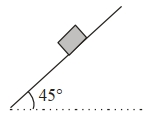
Consider a block kept on an inclined plane (inclined at $45^{\circ}$ ) as shown in the figure. If the force required to just push it up the incline is $2$ times the force required to just prevent it from sliding down, the coefficient of friction between the block and inclined plane $(\mu)$ is equal to
Consider two observers moving with respect to each other at a speed v along a straight line. They observe a block of mass m moving a distance l on a rough surface. The following quantities will be same as observed by the two observers.
The quantity on which the rise of liquid in capillary tube does not depend upon is
When $1\, gm$ of water at ${0^o}C$ and $1 \times {10^5}\;N/{m^2}$ pressure is converted into ice of volume $1.091\;c{m^2}$, the external work done will be
A gun of mass $10 \,kg$ fires $4$ bullets per second. The mass of each bullet is $20 \,g$ and the velocity of the bullet when it leaves the gun is $300\, m / s$. The force required to hold the gun while firing is (in $N$)