MCQ
In a parallel plate capacitor, the capacity increases if:
- AArea of the plate is decreased.
- BDistance between the plates is increases.
- CArea of the plate is increased.
- DDielectric constant decreases.
Explanation:
Hint:- Check the dependence of capacitance on certain quantities.
In a parallel plate capacitor, the capacitance is $\text{C}=\frac{\text{k}\in_0\text{A}}{\text{d}};$
Where, k is the dielectric constant, $\in_0$ is the permittivity constant, A is the area of the conduction and d is the distance between plates.
From here we can see C is directly proportional to k, $\in_0$,A and inversely proportional to d.
Generate a complete, print-ready paper with questions like this in minutes — across 16+ boards, with answer keys.
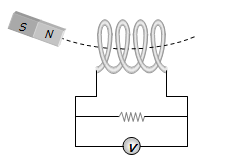
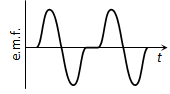
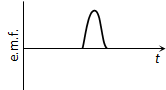
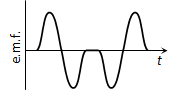
A magnet is made to oscillate with a particular frequency, passing through a coil as shown in figure. The time variation of the magnitude of e.m.f. generated across the coil during one cycle is
(a)
|
(b)
|
(c)
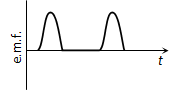
|
(d)
|
When one of the slits of Young’s experiment is covered with a transparent sheet of thickness 4.8 mm, the central fringe shifts to a position originally occupied by the 30th bright fringe. What should be the thickness of the sheet if the central fringe has to shift to the position occupied by 20th bright fringe
|
(a) 3.8 mm |
(b) 1.6 mm |
(c) 7.6 mm |
(d) 3.2 mm |
A P-type semiconductor can be obtained by adding
|
(a) Arsenic to pure silicon |
(b) Gallium to pure silicon |
|
(c) Antimony to pure germanium |
(d) Phosphorous to pure germanium |
The mobility of free electron is greater than that of free holes because
|
(a) The carry negative charge |
|
(b) They are light |
|
(c) They mutually collide less |
|
(d) They require low energy to continue their motion |