MCQ
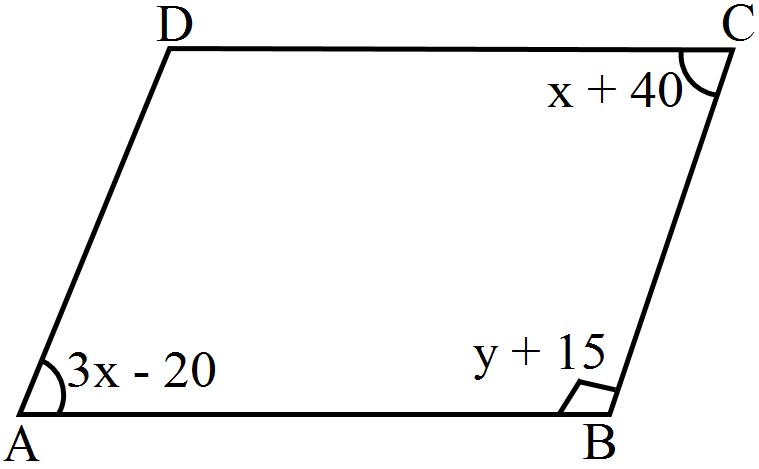
In a parallelogram $ABCD$ if $\angle\text{A = (3x - 20)}, \ \angle\text{ B = (Y + 15)}, \ \angle\text{C = (x + 40)}$ then find the value of $x$ and $y?$
  • A
    $x = 30^\circ $ and $y = 65^\circ $
  • $x = 30^\circ $ and $y = 95^\circ $
  • C
    $x = 32^\circ $ and $y = 95^\circ $
  • D
    $x = 38^\circ $ and $y = 85^\circ $

Answer

Correct option: B.
$x = 30^\circ $ and $y = 95^\circ $

 Given, $ABCD$ is a parallelogram.
So,
$\angle\text{A} =\angle\text{C} ($Opposite angles of parallelogram are equal in size$)$
$\Rightarrow 3x - 20 = x + 40$
$\Rightarrow 3x - x = 40 + 20$
$\Rightarrow 2x = 60$
$\Rightarrow x = 30^\circ $
Thus, $\angle\text{A} = 3 \times 30 - 20 = 90 - 20 = 70^\circ$
Now, $\angle\text{A}+\angle\text{B}=180^\circ ($Sum of interior angles of parallelogram is $180^\circ )$
$\Rightarrow 70^\circ + \angle\text{B} = 180^\circ$
$\Rightarrow \angle\text{B}= 180^\circ - 70^\circ$
$\Rightarrow \angle\text{B}= 110^\circ$
$\Rightarrow y + 15 = 110^\circ $
$\Rightarrow y = 95^\circ $
Hence, $x = 30^\circ $ and $y = 95^\circ $

Need a full question paper?

Generate a complete, print-ready paper with questions like this in minutes — across 16+ boards, with answer keys.

Start Generating Free