MCQ
In a parallelogram $ABCD$, if $\text{DAB} = 75^\circ$ and $\angle\text{DBC} = 60^\circ,$ then $\angle\text{BDC} =\ ?$
- A$50^\circ$
- ✓$45^\circ$
- C$65^\circ$
- D$75^\circ$
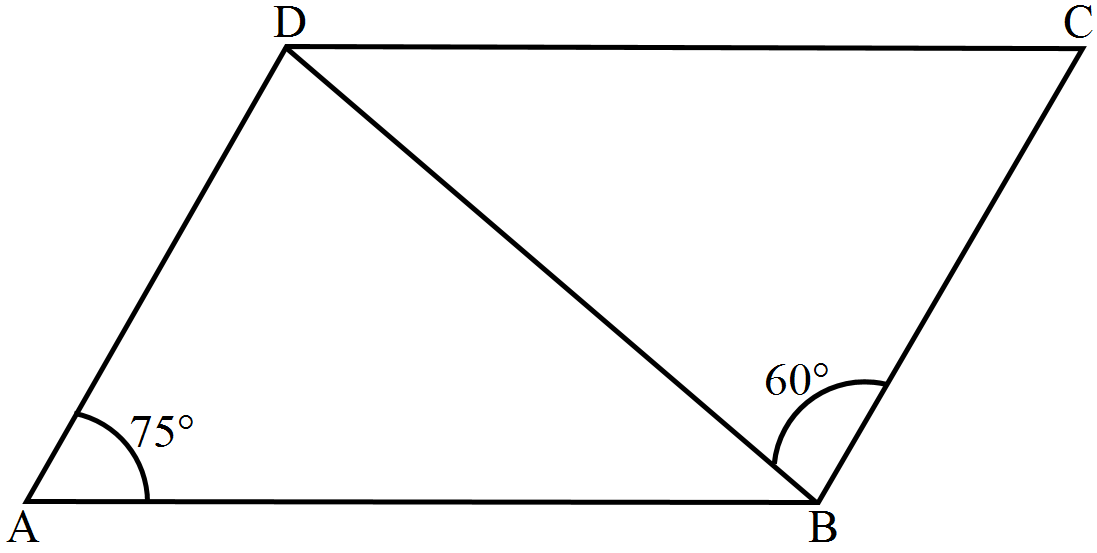
We know that the opposite angles of a parallelogram are equal.
Therefore, $\angle\text{BCD} = \angle\text{BAD} = 75^\circ...\ \text{(i)}$
$(i)$ Now, in $\triangle\text{BCD},$
We have,
$\angle\text{CDB} + \angle\text{DBC} + \angle\text{BCD} = 180^\circ$ [Since, sum of the angles of a triangle is $180^\circ ]$
$\Rightarrow \angle\text{CDB} + 60^\circ + 75^\circ = 180^\circ$
$\Rightarrow \angle\text{CDB} + 135^\circ = 180^\circ$
$\Rightarrow \angle\text{CDB} = (180^\circ - 135^\circ) = 45^\circ$
Generate a complete, print-ready paper with questions like this in minutes — across 16+ boards, with answer keys.