MCQ
In a photoemissive cell with executing wavelength $\lambda$, the fastest electron has speed $v$. If the exciting wavelength is changed to $3 \lambda / 4$, the speed of the fastest emitted electron will be
  • A
    $v(3 / 4)^{1 / 2}$
  • B
    $v(4 / 3)^{1 / 2}$
  • Less than $v(4 / 3)^{1 / 2}$
  • D
    Greater than $v(4 / 3)^{1 / 2}$

Answer

Correct option: C.
Less than $v(4 / 3)^{1 / 2}$
$ h v-W_0=\frac{1}{2} m v_{\max }^2 \Rightarrow \frac{h c}{\lambda}-\frac{h c}{\lambda_0}=\frac{1}{2} m v_{\max }^2 $
$ \Rightarrow h c\left(\frac{\lambda_0-\lambda}{\lambda \lambda_0}\right)=\frac{1}{2} m v_{\max }^2 \Rightarrow v_{\max }=\sqrt{\frac{2 hc}{m}\left(\frac{\lambda_0-\lambda}{\lambda \lambda_0}\right)}$
When wavelength is $\lambda$ and velocity is $v$, then$v=\sqrt{\frac{2 h c}{m}\left(\frac{\lambda_0-\lambda}{\lambda \lambda_0}\right)}$
When wavelength is $\frac{3 \lambda}{4}$ and velocity is $v^{\prime}$ then$v^{\prime}=\sqrt{\frac{2 h c}{m}\left[\frac{\lambda_0-(3 \lambda / 4)}{(3 \lambda / 4) \times \lambda_0}\right]}$
Divide equation (ii) by (i), we get
$ \frac{v^{\prime}}{v}=\sqrt{\frac{\left[\lambda_0-(3 \lambda / 4)\right]}{\frac{3}{4} \lambda \lambda_0 \times \frac{\lambda \lambda_0}{\lambda_0-\lambda}}} $
$ v^{\prime}=v\left(\frac{4}{3}\right)^{1 / 2}\sqrt{\frac{\left[\lambda_0-(3 \lambda / 4)\right]}{\lambda_0-\lambda}}$
$ \text { i.e. } v^{\prime}>v\left(\frac{4}{3}\right)^{1 / 2}$

Need a full question paper?

Generate a complete, print-ready paper with questions like this in minutes — across 16+ boards, with answer keys.

Start Generating Free

Similar questions

When white light passes through the achromatic combination of prisms, then what is observed
According to Joule's law of heating, heat produced $H=I^2 R t$, where $l$ is current, $R$ is resistance and $t$ is time. If the errors in the measurement of $l, R$ and $t$ are $3 \%, 4 \%$ and $6 \%$ respectively then error in the measurement of $H$ is
In an ac circuit, $V$ and $l$ are given by $V=100 \sin (100 t)$ volts, $I=100 \sin \left(100 t+\frac{\pi}{3}\right) m A$. The power dissipated in circuit is
If a liquid is heated in weightlessness, the heat is transmitted through
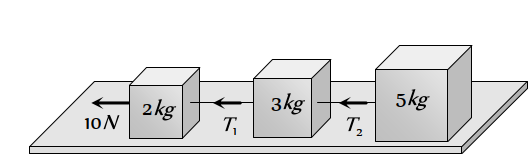
Three blocks of masses $2 kg , 3 kg$ and $5 kg$ are connected to each other with light string and are then placed on a frictionless surface as shown in the figure. The system is pulled by a force $F=10 N$, then tension $Q_1=$
Image
What is the resistance of a carbon resistance which has bands of colours brown, black and brown
In an ac circuit $l=100 \sin 200 \pi t$. The time required for the current to achieve its peak value will be
During the adiabatic expansion of $2$ moles of a gas, the internal energy was found to have decreased by $100 \mathrm{~J}$. The work done by the gas in this process is
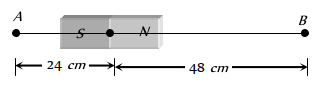
A bar magnet of length $3 \mathrm{~cm}$ has points $A$ and $B$ along its axis at distances of $24 \mathrm{~cm}$ and $48 \mathrm{~cm}$ on the opposite sides. Ratio of magnetic fields at these points will be
Image
$50 \mathrm{gm}$ of copper is heated to increase its temperature by $10^{\circ} \mathrm{C}$. If the same quantity of heat is given to $10 \mathrm{gm}$ of water, the rise in its temperature is (Specific heat of copper $=420$ Joule- $\mathrm{kg}^{\circ} \mathrm{C}$ )