MCQ
In a PN-junction
  • A
     P and N both are at same potential
  •  High potential at N side and low potential at P side
  • C
     High potential at P side and low potential at N side
  • D
    Low potential at N side and zero potential at P side

Answer

Correct option: B.
 High potential at N side and low potential at P side
High potential at N side and low potential at P side

Need a full question paper?

Generate a complete, print-ready paper with questions like this in minutes — across 16+ boards, with answer keys.
Start Generating Free

Similar questions

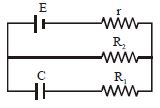
In the given figure each plate of capacitance $C$ has partial value of charge
Which of the following is vector quantity
A single slit of width $a$ is illuminated by a monochromatic light of wavelength $600\,nm$. The value of $a$ for which first minimum appears at $\theta=30^{\circ}$ on the screen will be ........... $\mu m$
An electromagnetic wave radiates outwards from a dipole antenna, with $E _0$​ as the amplitude of its electric field vector. The electric field $B _0$​​ which transports significant energy from the source falls off as:
A coil has resistance $30$ ohm and inductive reactance $20$ ohm at $50\,\, Hz$ frequency. If an ac source, of $200\,\, volt,\,\, 100\,\, Hz,$ is connected across the coil, the current in the coil will be ......$A$
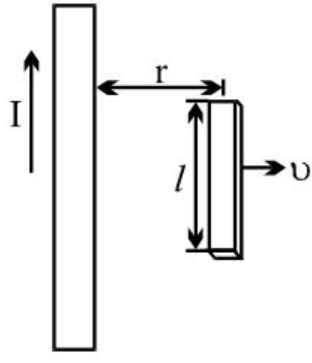
A long metal bar of $30 \ cm$ length is aligned along a north south line and moves eastward at a speed of $10 ms^{-1}$. A uniform magnetic field of $4.0 T$ points vertically downwards. If the south end of the bar has a potential of $0 V$ , the induced potential at the north end of the bar is:
Image
If a current increases from zero to one ampere in $0.1$ second in a coil of $5\ mH$, then the magnitude of the induced $e.m.f.$ will be.
${K_\alpha }$characteristic $X- $ ray refers to the transition
In an apparatus, the electric field was found to oscillate with an amplitude of 18 V/m. The magnitude of the oscillating magnetic field will be
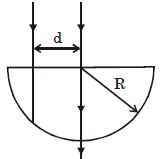
As shown, a narrow beam of light is incident onto a semi-circular glass cylinder of radius $R.$ Light can exit the cylinder when the beam is at the centre. When the beam is moved parallarly to a distance $d$ from the central line, no light can exit the cylinder from its lower surface. Find the refractive index of the glass.