MCQ
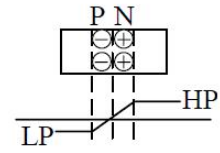
In a PN junction:
- AHigh potential at N side and low potential at P side.
- BHigh potential at P side and low potential at N side.
- CP and N both are at same potential.
- DUndetermined.
Explanation:
Generate a complete, print-ready paper with questions like this in minutes — across 16+ boards, with answer keys.
 has half life 5700 years. At the end of 11400 years, the actual amount left is
|
(a) 0.5 of original amount |
(b) 0.25 of original amount |
|
(c) 0.125 of original amount |
(d) 0.0625 of original amount |
To increase the angular magnification of a simple microscope, one should increase:
In the given circuit, the voltmeter records 5 volts. The resistance of the voltmeter in ohms is

|
(a) 200 |
(b) 100 |
(c) 10 |
(d) 50 |
In the following transitions, which one has higher frequency
|
(a) 3 – 2 |
(b) 4 – 3 |
(c) 4 – 2 |
(d) 3 – 1 |
If the amplitude ratio of two sources producing interference is 3 : 5, the ratio of intensities at maxima and minima is
|
(a) 25 : 16 |
(b) 5 : 3 |
(c) 16 : 1 |
(d) 25 : 9 |
Magnetic dipole moment is a
|
(a) Scalar quantity |
(b) Vector quantity |
(c) Constant quantity |
(d) None of these |