MCQ
In a potentiometer experiment, it is found that no current passes through the galvanometer when the terminals of the cell are connected across $52\ cm$ of the potentiometer wire. If the cell is shunted by a resistance of $ 5\,\Omega$, a balance is found when the cell is connected across $40\ cm$ of the wire. Find the internal resistance of the cell ........... $\Omega$
  • $1.5$ 
  • B
    $2 $
  • C
    $2.5 $ 
  • D
    $1$ 

Answer

Correct option: A.
$1.5$ 
a
Using formula, internal resistance,

$r=\left(\frac{l_{1}-l_{2}}{l_{2}}\right) s=\left(\frac{52-40}{40}\right) \times 5=1.5 \Omega$

Need a full question paper?

Generate a complete, print-ready paper with questions like this in minutes — across 16+ boards, with answer keys.

Start Generating Free

Similar questions

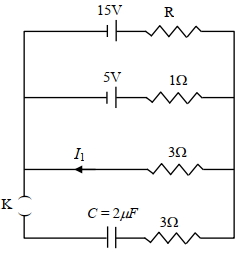
In a circuit shown in the figure, the capacitor $C$ is initially uncharged and the key $K$ is open. In this condition, a current of $1 \mathrm{~A}$ flows through the $1 \Omega$ resistor. The key is closed at time $t=t_0$. Which of the following statement($s$) is(are) correct?

[Given: $\mathrm{e}^{-1}=0.36$ ]

($A$) The value of the resistance $R$ is $3 \Omega$.

($B$) For $t$

($C$) At $t=t_0+7.2 \mu \mathrm{s}$, the current in the capacitor is $0.6 \mathrm{~A}$.

($D$) For $t \rightarrow \infty$, the charge on the capacitor is $12 \mu C$.

The $X-$ rays produced in a coolidge tube of potential difference $40V$ have minimum wavelength of
A point source of light is placed at $2 f$ from a converging lens of focal length $f$. A flat mirror is placed on the other side of the lens at a distance $d$ such that rays reflected from the mirror are parallel after passing through the lens again. If $f=30 \,cm$, then $d$ is equal to ............. $cm$
If a lens is moved towards the object from a distance of $40 \,cm$ to $30 \,cm$, the magnification of the image remains the same (numarically). The focal length of the lens is ......... $cm$
The ratio of the frequencies of the long wavelength limits of Lyman and Balmer series of hydrogen spectrum is
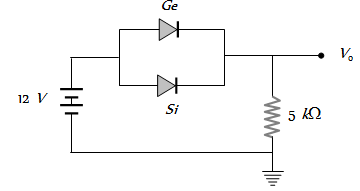
Ge and Si diodes conduct at 0.3 V and 0.7 V respectively. In the following figure if Ge diode connection are reversed, the valve of $V_0$ changes by
$99 \%$ of a radioactive element will decay between
The charge flowing through a resistance $R$ varies with time according to $Q = at -bt^2.$ The total heat produced in $R$ is : (assume that direction of current not reversed)
The resistivity of alloys $ = {R_{{\rm{alloy}}}}$; the resistivity of constituent metals ${R_{{\rm{metal}}}}$. Then, usually
A charge ${q_1}$ exerts some force on a second charge ${q_2}$. If third charge ${q_3}$ is brought near, the force of ${q_1}$ exerted on ${q_2}$