Question

In a potentiometer experiment, the galvanometer shows no deflection when a cell is connected across 60 cm of the potentiometer wire. If the cell is shunted by a resistance of 6Ω, the balance is obtained across 50 cm of the wire. The internal resistance of the cell is

(a) 0.5 Ω

(b) 0.6 Ω

(c) 1.2 Ω

(d) 1.5 Ω

Answer

(c) 1.2 Ω

Need a full question paper?

Generate a complete, print-ready paper with questions like this in minutes — across 16+ boards, with answer keys.

Start Generating Free

Similar questions

A thin circular ring of mass M and radius r is rotating about its axis with an angular speed $\omega.$ Two particles having mass m each are now attached at diametrically opposite points. The angular speed of the ring will become:

  1. $\frac{\omega\text{M}}{\text{M}+\text{m}}$

  2. $\frac{\omega\text{M}}{\text{M}+\text{2m}}$

  3. $\frac{\omega(\text{M}-\text{2m})}{\text{M}+\text{2m}}$

  4. $\frac{\omega(\text{M}+\text{2m})}{\text{M}}$

The true statement for thermo e.m.f. of a thermocouple

(a) Depends on the nature of metals

(b) Depends only on temperature of cold junction

(c) Depends only on temperature of hot junction

(d) Depends on the length of the wires used for thermocouple

Magnetic lines of force:
An electric dipole is placed in an electric field generated by a point charge.
Direction of force due to magnetic field on a moving charged particle is:

  1. Perpendicular to direction of velocity of charged particle.
  2. Perpendicular to direction of magnetic field.
  3. Parallel to direction of velocity of charged particle.
  4. Parallel to the direction of magnetic field.

Correct statements are.

    A conducting circular loop is placed in a uniform magnetic field, $B =0.025 T$ with its plane perpendicular to the loop. The radius of the loop is made to shrink at a constant rate of $1 mm s ^{-1}$. The induced emf when the radius is 2 cm , is

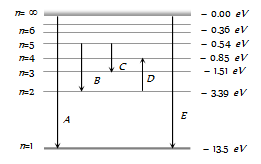
    The energy levels of the hydrogen spectrum is shown in figure. There are some transitions A, B, C, D and E. Transition A, B and C respectively represent

    (a) First member of Lyman series, third spectral line of Balmer series and the second spectral line of Paschen series

    (b) Ionization potential of hydrogen, second spectral line of Balmer series and third spectral line of Paschen series

    (c) Series limit of Lyman series, third spectral line of Balmer series and second spectral line of Paschen series

    (d) Series limit of Lyman series, second spectral line of Balmer series and third spectral line of Paschen series

    V-i graphs for parallel and series combination of two identical resistors are as shown in figure. Which graph represents parallel combination

    (a) A

    (b) B

    (c) A and B both

    (d) Neither A nor B

    A lens of power +2 diopters is placed in contact with a lens of power – 1 diopter. The combination will behave like

    (a) A convergent lens of focal length 50 cm

    (b) A divergent lens of focal length 100 cm

    (c) A convergent lens of focal length 100 cm

    (d) A convergent lens of focal length 200 cm

    A long copper tube of inner radius R carries a current i. The magnetic field B inside the tube is

    (a)  

    (b)

    (c)

    (d) Zero