In a potentiometer wire experiment the $\mathrm{emf}$ of a battery in the primary circuit is $20\,V$ and its internal resistance is $5\,\Omega$ . There is a resistance box in series with the battery and the potentiometer wire, whose resistance can be varied from $120\,\Omega$ to $170\,\Omega$ . Resistance of the potentiometer wire is $75\,\Omega$ . The following potential differences can be measured using this potentiometer.
Diffcult


Download our appand get started for free
Experience the future of education. Simply download our apps or reach out to us for more information. Let's shape the future of learning together!No signup needed.*
Similar Questions
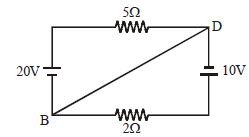
- 1Calculate the current in wire $BD$ ................ $A$View Solution
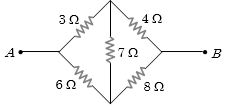
- 2Calculate the net resistance of the circuit between $A$ and $B$View Solution
- 3Three unequal resistors in parallel are equivalent to a resistance $1\, ohm$. If two of them are in the ratio $1 : 2$ and if no resistance value is fractional, the largest of the three resistances in $ohms$ isView Solution
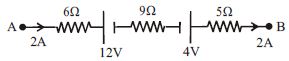
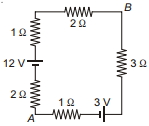
- 4The potential difference between $A$ and $B$ in the Figure is .............. $V$View Solution
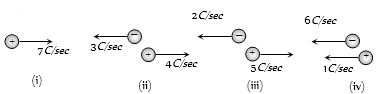
- 5View SolutionFollowing figure shows four situations in which positive and negative charges moves horizontally through a region and gives the rate at which each charge moves. Rank the situations according to the effective current through the region greatest first
- 6Potential difference $V_B-V_A$ in the network shown is ............. $V$View Solution
- 7In an experiment of meter bridge, a null point is obtained at the centre of the bridge wire. When a resistance of $10\, ohm$ is connected in one gap, the value of resistance in other gap is ............. $\Omega$View Solution
- 8The length of a wire of a potentiometer is $100\, cm$, and the $emf$ of its standard cell is $E\,volt$. It is employed to measure the $e.m.f$ of a battery whose internal resistance is $0.5 \,\Omega$. If the balance point is obtained at $l = 30\, cm$ from the positive end, the $e.m.f.$ of the battery isView Solution
where $i$ is the current in the potentiometer
- 9A potential difference of $10 \,V$ is applied across a conductor of $1000 \,\Omega$. The number of electrons flowing through the conductor in $300 \,s$ is ..........View Solution
- 10An expression for rate of heat generated, if a current of $I$ ampere flows through a resistance of $R$ $\Omega$, isView Solution