MCQ
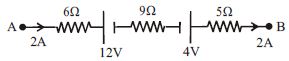
The potential difference between $A$ and $B$ in the Figure is .............. $V$
  • A
    $24$
  • B
    $14$
  • C
    $32$
  • $48$

Answer

Correct option: D.
$48$
d
$V_A -20\times2 -12 + 4 = V_B$
$V_A -V_B = 48\, V$

Need a full question paper?

Generate a complete, print-ready paper with questions like this in minutes — across 16+ boards, with answer keys.

Start Generating Free

Similar questions

On a long horizontal belt, a child runs to and fro with a speed of $9\,km/h$ (with respect to the belt) between his father and mother located $50\,m$ apart on the moving belt. The belt moves with a speed of $4\,km/h.$ For an observer on the platform the speed of the child in the direction of motion of the belt is.........$km/h$
An incompressible fluid flows steadily through a cylindrical pipe which has radius $2r$ at point $A $ and radius $r $ at $B $ further along the flow direction. If the velocity at point $A$  is $v, $ its velocity at point $B$  is
A hydrogen atom in its ground state absorbs $10.2\ eV$ of energy. The orbital angular momentum is increased by

(Given Planck constant $h = 6.6 \times {10^{ - 34}}J -  sec$)

When two sound waves with a phase difference of $\pi /2$, and each having amplitude $A$ and frequency $\omega $, are superimposed on each other, then the maximum amplitude and frequency of resultant wave is
In an $n-$type silicon, which of the following statement is true
A hollow double concave lens is made of very thin transparent material. It can be filled with air or either of two liquids $L_1$ and $L_2$ having refractive indices $n_1$ and $n_2$ respectively ($n_2>n_1>1$). The lens will diverge a parallel beam of light if it is filled with
A wheel having moment of inertia $2\,kg-m^2$ about its vertical axis, rotates at the rate of $60\,rpm$ about the axis. The torque which can stop the wheel’s rotation in one minute would be
A pin or a needle floats on the surface of water, the reason for this is
For protecting a sensitive equipment from the external magnetic field, it should be
When monochromatic radiation of intensity $I$ falls on a metal surface, the number of photoelectrons and their maximum kinetic energy are $N$ and $K$ respectively. If the intensity of radiation is $2I$, the number of emitted electrons and their maximum kinetic energy are respectively