Question
In a projectile motion the velocity:
  1. Is always perpendicular to the acceleration.
  2. Is never perpendicular to the acceleration.
  3. Is perpendicular to the acceleration for one instant only.
  4. Is perpendicular to the acceleration for two instants.
Answer

  1. Is perpendicular to the acceleration for one instant only.
Explanation:
In projectile motion, velocity is perpendicular to acceleration only at the highest point. Here, velocity is along the horizontal direction and acceleration is along the vertically downward direction.

Need a full question paper?

Generate a complete, print-ready paper with questions like this in minutes — across 16+ boards, with answer keys.

Start Generating Free

Similar questions

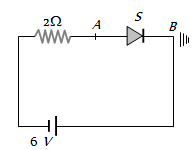
The diode shown in the circuit is a silicon diode. The potential difference between the points $A$ and $B$ will be
The molecules in which centres of positive and negative charges are separated are called as:
The breakdown in a reverse biased $p-n$ junction diode is more likely to occur due to:
$X-$rays are produced in $X-$ray tube operating at a given accelerating voltage. The wavelength of the continuous $X-$rays has values from
When water droplets merge to form a bigger drop:
  1. Energy is liberated.
  2. Energy is absorbed.
  3. Energy is neither liberated nor absobred.
  4. Energy may either be liberated or absorbed depending on the nature of the liquid.
A man can see the objects upto a distance of one metre from his eyes. For correcting his eye sight so that he can see an object at infinity, he requires a lens whose power is(a) + 0.5 D(b)  + 1.0 D  (c) + 2.0 D(d)  – 1.0 D 
       
For driving a current of 2 A for 6 minutes in a circuit, 1000 J of work is to be done.  The e.m.f. of the source in the circuit is(a) 1.38 V(b) 1.68 V(c) 2.04 V (d) 3.10 V
       
The slits in a Young's double slit experiment have equal width and the source is placed symmetrically with respect to the slits. The intensity at the central fringe is $I_0$. If one of the slits is closed, the intensity at this point will be:
In which type of molecule positive and negative charges coincide with each other?
In an interference experiment, third bright fringe is obtained at a point on the screen with a light of 700 nm. What should be the wavelength of the light source in order to obtain 5th bright fringe at the same point(a) 500 nm(b) 630 nm (c) 750 nm(d) 420 nm