Question
The breakdown in a reverse biased $p-n$ junction diode is more likely to occur due to:

Answer

Large velocity of the minority charge carriers if the doping concentration is small.
Strong electric field in the depletion region if the doping concentration is large.
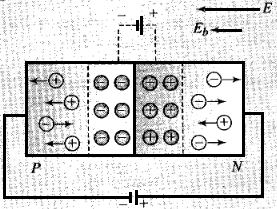
Reverse biasing : Positive terminal of the battery is connected to the $N-$ crystal and negative terminal of the battery is connected to $P-$ crystal.
  1. In reverse biasing width of depletion layer increases
  2. In reverse biasing resistance offered $R_\text{Reverse} = 10^5\Omega .$
  3. Reverse bias supports the potential barrier and no current flows across the junction due to the diffusion of the majority carriers.
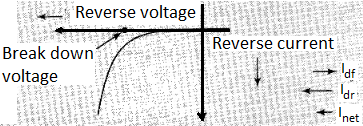
  1. $($A very small reverse current may exist in the circuit due to the drifting of minority carriers across the junction$)$
  2. Break down voltage : Reverse voltage at which break down of semiconductor occurs.
  3. For Ge it is $25V$ and for $ Si$ it is $35V$.

So, we conclude that in reverse biasing, ionization takes place because the minority charge carriers will be accelerated due to reverse biasing and striking with atoms which in turn cause secondary electrons and thus more number of charge carriers.
When doping concentration is large, there will be a large number of ions in the depletion region, which will give rise to a strong electric field.

Need a full question paper?

Generate a complete, print-ready paper with questions like this in minutes — across 16+ boards, with answer keys.
Start Generating Free

Similar questions

The force of repulsion between two point charges is F, when these are 1m apart. Now the point charges are replaced by conducting spheres of radii 5cm having the charge same as that of point charges. The distance between their centres is 1m, then the force of repulsion will:
At room temperature, copper has free electron density of $8.4 \times 10^{28}$ per $\mathrm{m}^3$ The copper conductor has a cross$-$section of $10^{-6} \mathrm{~m}^2$ and carries a current of $5.4 A .$ The electron drift velocity in copper is
The distance between the extreme points on the periphery of the mirror is called:
Conventional flow of current will always be from:
Among the two interfering monochromatic sources A and B; A is ahead of B in phase by 66°. If the observation be taken from point P, such that PB – PA = l/4. Then the phase difference between the waves from A and B reaching P is (a) 156°(b) 140°(c) 136°(d) 126°
       
Two nucleons are at a separation of $1\ fm.$ The net force between them is $F_1$​ if both are neutrons, $F_2$​ if both are protons, and $F_3$​ if one is a proton and the other is a neutron then:
Point charges $+4 q,-q$ and $+4 q$ are kept on the $X$-axis at points $x=0, x=a$ and $x=2$ a respectively:
The maximum focal length of the eye-lens of a person is greater than its distance from the retina. The eye is:
Binding energy of a nucleus is(a) Energy given to its nucleus during its formation(b) Total mass of nucleus converted to energy units(c) Loss of energy from the nucleus during its formation(d) Total K.E. and P.E. of the nucleons in the nucleus


A parallel plate capacitor is connected to a battery. The plates are pulled apart with a uniform speed. If $x$ is the separation between the plates, the time rate of change of electrostatic energy of capacitor is proportional to