Question
In a projectile motion the velocity:
  1. Is always perpendicular to the acceleration.
  2. Is never perpendicular to the acceleration.
  3. Is perpendicular to the acceleration for one instant only.
  4. Is perpendicular to the acceleration for two instants.

Answer

  1. Is perpendicular to the acceleration for one instant only.

Explanation:

In projectile motion, velocity is perpendicular to acceleration only at the highest point. Here, velocity is along the horizontal direction and acceleration is along the vertically downward direction.

Need a full question paper?

Generate a complete, print-ready paper with questions like this in minutes — across 16+ boards, with answer keys.

Start Generating Free

Similar questions

During a negative beta decay

(a) An atomic electron is ejected

(b) An electron which is already present within the nucleus is ejected

(c) A neutron in the nucleus decays emitting an electron

(d) A part of the binding energy is converted into electron

If  and  are respectively, the electric permittivity and the magnetic permeability of free space, ε and μ the corresponding quantities in a medium, the refractive index of the medium is

(a)  

(b)

(c)

(d)

While using an electric bulb, the reflection for street lighting should be from

(a) Concave mirror

(b) Convex mirror

(d) Parabolic mirror

(d) Parabolic mirror

The angle between the earth's magnetic and the earth's geographical axes is

(a) Zero

(b) 17°

(c) 23°

(d) None of these

An electric dipole is placed in an electric field generated by a point charge.
  1. The net electric force on the dipole must be zero.
  2. The net electric force on the dipole may be zero.
  3. The torque on the dipole due to the field must be zero.
  4. The torque on the dipole due to the field may be zero.
The experiment required to demonstrate the electromagnetic induction was performed by :

A square coil   area is placed perpendicular to a uniform magnetic field of intensity . The magnetic flux through the coil is

(a) 10 weber

(b)  weber

(c)  weber

(d) 100 weber

A ray of light incident normally on an isosceles right angled prism travels as shown in the figure. The least value of the refractive index of the prism must be

(a)  

(b)  

(c) 1.5

(d) 2.0

Which of the following statement is correct in accordance with Kirchhoff's second law?
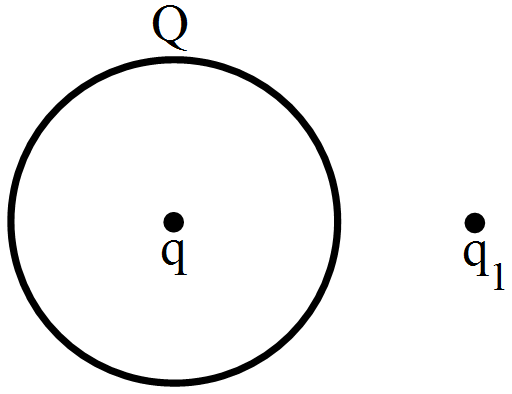
A thin, metallic spherical shell contains a charge Q on it. A point charge q is placed at the centre of the shell and another charge q1 is placed outside it as shown in figure. All the three charges are positive. The force on the charge at the centre is:

  1. Towards left.
  2. Towards right.
  3. Upward.
  4. Zero.