Question
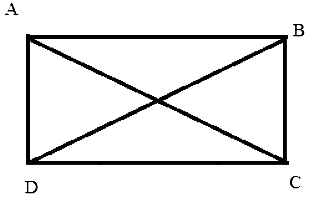
In a rectangle $\text{ABCD}$,prove that: $AC^2+ BD^2= AB^2+ BC^2+ CD^2+ DA^2$.

Answer


Pythagoras theorem states that in a right$-$angled triangle,
the square on the hypotenuse is equal to the sum of the squares on the remaining two sides.
Since, $\text{ABCD}$ is a rectangle angles $A, B, C$ and $D$ are rt. angles.
First, we consider the $\triangle A C D$, and applying Pythagoras theorem we get,
$AC ^2= DA ^2+ CD ^2\dots ....(i)$
Similarly, we get from rt. angle$ \triangle BDC$ we get,
$BD ^2= BC ^2+ CD ^2$
$=B C^2+A B^2\ldots .[$ In a rectangle, opposite sides are equal, $\therefore C D=AB ] \ldots (ii)$
Adding $(i)$ and $(ii)$
$A C^2+B D^2=A B^2+B C^2+C D^2+D A^2$
Hence proved.

Need a full question paper?

Generate a complete, print-ready paper with questions like this in minutes — across 16+ boards, with answer keys.
Start Generating Free

Similar questions

Simplify by rationalising the denominator in the following.$\frac{2 \sqrt{3}-\sqrt{6}}{2 \sqrt{3}+\sqrt{6}}$
Construct a quadrilateral ABCD in which $AB =3.2 cm, BC =2.8 cm, CD =4 cm$, $DA =4.5 cm$ and $BD =5.3 cm$. Also construct a triangle equal in area to this quadrilateral.
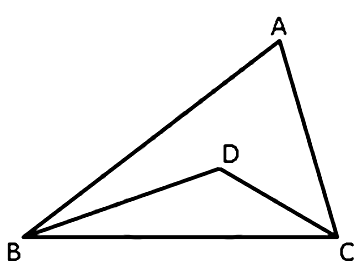
In $\triangle ABC, D$ is a point in the interior of the triangle. Prove that $DB + DC < AB + AC.$
Sunil borrows $Rs. 50,000$ at $10 \% S.I.$ for $1 \frac{1}{2}$ years. He immediately invests the entire amount for $1 \frac{1}{2}$ years at $10 \%$ compounded annually. What is his gain at the end of the stipulated time, when he repays his loan?
From a point $O$ in the interior of a $\triangle ABC$, perpendicular $OD, OE$ and $OF$ are drawn to the sides $BC, CA$ and $AB$ respectively. Prove that: $AF^2 + BD^2 + CE^2 = AE^2 + CD^2 + BF^{2 }$
If $m=x-3$ and $\frac{4 m-3}{2}-\frac{3 m-1}{5}=\frac{3}{2}$, find $x$.
The cost of papering the four walls of a room at $75$ paise per square meter $Rs. 240.$ The height of the room is $5$ meters. Find the length and the breadth of the room, if they are in the ratio $5 : 3.$
In a $\triangle ABC$, if $D$ is midpoint of $BC; AD$ is produced upto $E$ such as $DE = AD$, then prove that:$a. \text{DABD}$ and $\text{DECD}$ are congruent.$b. AB = EC,c. AB$ is parallel to $EC$
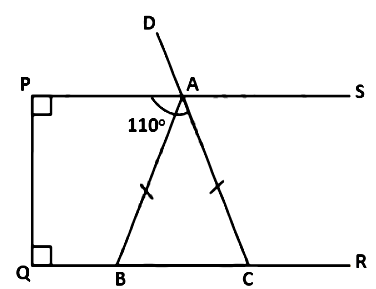
In the given figure, if $\text{DABC}$ is an isosceles triangle and $\angle PAC = 110^o,$ find the base angle and vertex angle of the $\text{DABC}.$
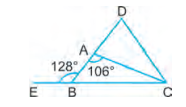
In the given figure, side $B A$ of $\triangle A B C$ has been produced to D such that $CD = CA$ and side CB has been produced to E . If $\angle BAC =106^{\circ}$ and $\angle ABE =128^{\circ}$, find $\angle BCD$.
Image