Questions

[5 marks sum]

🎯

Test yourself on this topic

14 questions · timed · auto-graded

Question 15 Marks
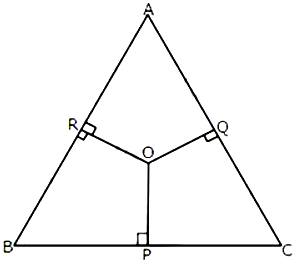
In the following figure, $O P, O Q$ and $O R$ are drawn perpendiculars to the sides $B C, C A$ and $A B$ respectively of $\triangle A B C$.Prove that: $AR ^2+ BP ^2+ CQ ^2= AQ ^2+ CP ^2+ BR ^2$
Answer
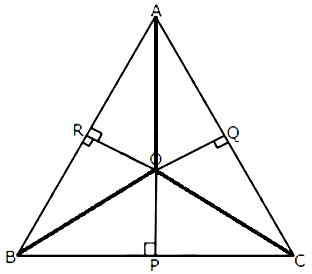
Here, we first need to join $OA , OB$, and $OC$ after which the figure becomes as follows,
Pythagoras theorem states that in a right$-$angled triangle,
the square on the hypotenuse is equal to the sum of the squares on the remaining two sides.
First, we consider the $\triangle A R O$ and applying Pythagoras theorem we get,
$A Q^2=A R^2+O R^2$
$A R^2=A O^2-O R^2 \ldots....(i)$
Similarly, from triangles, $\text{BPO , COQ , AOQ , CPO}$, and $\text{BRO}$ we get the following results,
$BP ^2= BO ^2-O P^2 \ldots....(ii)$
$C Q^2=O C^2-O Q^2 \ldots....(iii)$
$AQ ^2= AO ^2- OQ ^2 \ldots....(iv)$
$C P^2=O C^2-O P^2\ldots....(v)$
$BR ^2=O B^2-O R^2\ldots....(vi)$
Adding $(i), (ii)$ and $(iii)$, we get
$A R^2+B P^2+C Q^2=A O^2-O R^2+B O^2-O P^2+O C^2-O Q^2 \ldots....(vii)$
Adding $(iv), (v)$ and $(vi),$ we get,
$A Q^2+C P^2+B R^2=A O^2-O R^2+B O^2-O P^2+O C^2-O Q^2 \ldots....(viiii)$
From $(vii)$ and $(viii)$, we get,
$A R^2+B^2+C Q^2=A Q^2+C P^2+B R^2$
Hence proved.
 
View full question & answer
Question 25 Marks
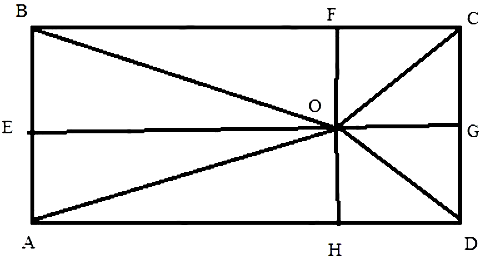
$O$ is any point inside a rectangle $\text{ABCD}$.Prove that: $OB^2+ OD^2= OC^2+ OA^2$.
Answer

Draw rectangle $\text{ABCD}$ with arbitrary point $O$ within it, and then draw lines $O A, O B, O C, O D$. Then draw lines from point $O$ perpendicular to the sides: $OE , OF , OG , OH$.
Pythagoras theorem states that in a right-angled triangle,
the square on the hypotenuse is equal to the sum of the squares on the remaining two sides.
Using Pythagorean theorem we have from the above diagram:
$ O A^2=A H^2+O H^2=A H^2+A^2$
$ O C^2=C G^2+O G^2= EB ^2+ HD ^2$
$ O B^2=E O^2+ BE ^2=A H^2+ BE ^2$
$ O D^2= HD ^2+ OH ^2= HD ^2+ AE ^2$
Adding these equalities we get:
$O A^2+O C^2=A H^2+H D^2+A E^2+E B^2$
$ O B^2+O D^2=A H^2+H D^2+A E^2+E B^2$
From which we prove that for any point within the rectangle there is the relation
$O A^2+O C^2=O B^2+O D^2$
Hence Proved.
View full question & answer
Question 35 Marks
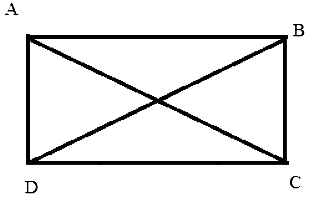
In a rectangle $\text{ABCD}$,prove that: $AC^2+ BD^2= AB^2+ BC^2+ CD^2+ DA^2$.
Answer

Pythagoras theorem states that in a right$-$angled triangle,
the square on the hypotenuse is equal to the sum of the squares on the remaining two sides.
Since, $\text{ABCD}$ is a rectangle angles $A, B, C$ and $D$ are rt. angles.
First, we consider the $\triangle A C D$, and applying Pythagoras theorem we get,
$AC ^2= DA ^2+ CD ^2\dots ....(i)$
Similarly, we get from rt. angle$ \triangle BDC$ we get,
$BD ^2= BC ^2+ CD ^2$
$=B C^2+A B^2\ldots .[$ In a rectangle, opposite sides are equal, $\therefore C D=AB ] \ldots (ii)$
Adding $(i)$ and $(ii)$
$A C^2+B D^2=A B^2+B C^2+C D^2+D A^2$
Hence proved.
View full question & answer
Question 45 Marks
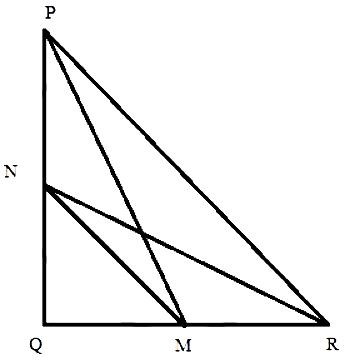
$M$ and $N$ are the mid$-$points of the sides $QR$ and $PQ$ respectively of a $\text{PQR}$, right$-$angled at $Q.$Prove that:$(i) PM^2+ RN^2= 5 MN^2,(ii) 4 PM^2= 4 PQ^2+ QR^2,$$(iii) 4 RN^2= PQ^2+ 4 QR^2(iv) 4 (PM^2+ RN^2) = 5 PR^2$
Answer

We draw, $PM, MN, NR$
Pythagoras theorem states that in a right$-$angled triangle,
the square on the hypotenuse is equal to the sum of the squares on the remaining two sides.
Since $M$ and $N$ are the mid-points of the sides $Q R$ and $P Q$ respectively,
$​​​​​​​\therefore, PN = NQ , QM = RM$
$(i)$ First, we consider the $\triangle PQM$, and applying Pythagoras theorem we get,
$PM ^2= PQ ^2+ MQ ^2$
$=( PN + NQ )^2+ MQ ^2$
$= PN + NQ ^2+2 PN \cdot NQ + MQ ^2$
$= MN ^2+ PN ^2+2 PN . NQ \ldots\left[\right.$ From $\left., \Delta MNQ , MN ^2= NQ ^2+ MQ ^2\right] \ldots \ldots .. (i)$
Now, we consider the $\triangle RNQ$, and applying Pythagoras theorem we get,
$R^2=N Q^2+R Q^2$
$=N Q^2+(Q M+R M)^2$
$=N Q^2+Q^2+R M^2+2 Q M \cdot R M$
$= MN ^2+ RM ^2+2 QM \cdot RM .......(ii)$
Adding $(i)$ and $(ii)$ we get,
$PM ^2+ RN ^2= MN ^2+ PN ^2+2 PN \cdot NQ + MN ^2+ RM ^2+2 QM \cdot RM$
$PM ^2+ RN ^2=2 MN ^2+ PN ^2+ RM ^2+2 PN \cdot NQ +2 QM \cdot RM$
$PM ^2+ RN ^2=2 MN ^2+ NQ ^2+ QM ^2+2\left( QN ^2\right)+2\left( QM ^2\right)$
$PM ^2+ RN ^2=2 MN ^2+ MN ^2+2 MN ^2$
$PM ^2+ RN ^2=5 MN ^2$
Hence Proved.
$(ii)$ We consider the $\triangle PQM$, and applying Pythagoras theorem we get,
$PM ^2= PQ ^2+ MQ ^2$
$4 PM ^2=4 PQ ^2+4 MQ ^2 \dots... $[ Multiply both sides by $4]$
$4 PM ^2=4 PQ ^2+4 \cdot\left(\frac{1}{2} QR \right)^2 \ldots\left[ MQ =\frac{1}{2} QR \right]$
$4 PM ^2=4 PQ ^2+4 PQ +4 \cdot \frac{1}{4} QR ^2$
$4 PM ^2=4 PQ ^2+ QR ^2$
Hence Proved.
$(iii)$ We consider the $\triangle RQN$, and applying Pythagoras theorem we get,
$R N^2=N Q^2+R Q^2$
$4 RN ^2=4 NQ ^2+4 QR ^2 \ldots[$ Multiplying both sides by 4$]$
$4 RN ^2=4 QR ^2+4 \cdot(1 / 2 PQ )^2 \ldots\left[ NQ =\frac{1}{2} PQ \right]$
$4 RN ^2=4 QR ^2+4 \cdot \frac{1}{4} PQ ^2$
$4 RN { }^2= PQ ^2+4 QR ^2
$Hence Proved.
$(iv)$ First, we consider the $\triangle PQM$, and applying Pythagoras theorem we get,
$PM ^2= PQ ^2+ MQ ^2$
$=( PN + NQ )^2+ MQ ^2$
$= PN ^2+ NQ ^2+2 PN \cdot NQ + MQ ^2$
$= MN ^2+ PN ^2+2 PN . NQ \ldots[$ From,  $\Delta MNQ _1= MN ^2= NQ ^2+ MQ ^2] \ldots \ldots(i)$
Now, we consider the $\triangle RNQ$, and applying Pythagoras theorem we get,
$RN ^2+ NQ ^2+ RQ ^2$
$=N Q^2+(Q M+R M)^2$
$= NQ ^2+ QM ^2+ RM ^2+2 QM \cdot RM$
$= MN ^2+ RM ^2+2 QM \cdot RM \ldots \ldots .. (ii)$
Adding $(i)$ and $(ii)$ we get,
$PM ^2+ RN ^2= MN ^2+ PN ^2+2 PN \cdot NQ + MN ^2+ RM ^2+2 QM \cdot RM$
$PM ^2+ RN ^2=2 MN ^2+ PN ^2+ RM ^2+2 PN \cdot NQ +2 QM \cdot RM$
$PM ^2+ RN ^2=2 MN ^2+ NQ ^2+ QM ^2+2\left( QN ^2\right)+2\left( QM ^2\right)$
$PM ^2+ RN ^2=2 MN ^2+ MN ^2+2 MN ^2$
$P M^2+ RN ^2=5 MN ^2$
$4\left( PM ^2+ RN ^2\right)=4 \cdot 5 \cdot\left( NQ ^2+ MQ ^2\right)$
$4\left( PM ^2+ RN ^2\right)=4.5$
${\left[\left(\frac{1}{2} PQ \right)^2+\left(\frac{1}{2} RQ \right)^2\right] \ldots\left[\because NQ =\frac{1}{2} PQ , MQ =\frac{1}{2} QR \right]}$
$4\left(P M^2+R N^2\right)=5 P R^2$
Hence Proved.
View full question & answer
Question 55 Marks
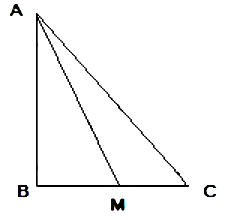
$\text{ABC}$ is a triangle, right$-$angled at $B. M$ is a point on $BC$.Prove that: $AM^2+ BC^2= AC^2+ BM^2$.
Answer
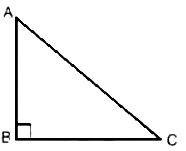
The pictorial form of the given problem is as follows,

Pythagoras theorem states that in a right-angled triangle, the square on the hypotenuse is equal to the sum of the squares on the remaining two sides.
First, we consider the $\triangle A B M$ and applying Pythagoras theorem we get,
$AM ^2= AB + BM ^2$
$A B^2=A M^2-B M^2 \dots......(i)$
Now, we consider the $\triangle A B C$ and applying Pythagoras theorem we get,
$A C^2=A B^2+B C^2$
$A B^2=A C^2-B C^2\dots......(ii)$
From $(i)$ and $(ii)$ we get,
$A M^2 \cdot B M^2=A C^2-B C^2$
$A M^2+B C^2=A C^2+B M^2$
Hence Proved
View full question & answer
Question 65 Marks
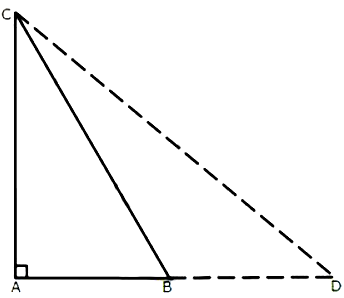
In $\triangle A B C, \angle A=90^{\circ}, C A=A B$ and $D$ is the point on $A B$ produced.Prove that $D C^2-B D^2=2 A B \cdot A D$.
Answer
Pythagoras theorem states that in a right-angled triangle, the square on the hypotenuse is equal to the sum of the squares on the remaining two sides.
We consider the rt. angled $\triangle ACD$ and applying Pythagoras theorem we get,
$C D^2=A C^2+A D^2$
$C D^2=A C^2+(A B+B D)^2 \ldots .[\because A D=A B+B D]$
$C D^2=A C^2+A B^2+B D^2+2 A B \cdot B D\ldots(i)$
Similarly, in $\triangle ABC$,
$B C^2=A C^2+A B^2$
$B C^2=2 A B^2\ldots[ AB = AC ]$
$AB ^2=\frac{1}{2} BC ^2 \dots..(ii)$
Putting, $AB^2$ from $(ii)$ in $(i),$ We get,
$C D^2=A C^2+\frac{1}{2} B C^2+B D^2+2 A B \cdot B D$
$ C D^2-B D^2=A B^2+A B^2+2 A B \cdot(A D-A B)$
$ C D^2-B D^2=A B^2+A B^2+2 A B \cdot A D-2 A B^2$
$ C D^2-B D^2=2 A B \cdot A D$
$ D C^2-B D^2=2 A B \cdot A D$
Hence Proved.
View full question & answer
Question 75 Marks
In an isosceles $\triangle ABC; AB = AC$ and $D$ is the point on $BC$ produced.Prove that: $AD^2= AC^2+ BD.CD$.
Answer

In an isosceles $\triangle A B C ; A B=A C$ and $D$ is the point on $B C$ produced.
Construct $AE$ perpendicular $BC$.
Pythagoras theorem states that in a right$-$angled triangle,
the square on the hypotenuse is equal to the sum of the squares on the remaining two sides.
We consider the rt. angled $\triangle AED$ and applying Pythagoras theorem we get,
$A D^2=A E^2+E D^2$
$A D^2=A E^2+(E C+C D)^2 \ldots . .(i)[\because E D=E C+C D]$
Similarly, in $\triangle A E C$,
$A C^2=A E^2+E C^2$
$AE ^2= AC ^2- EC ^2 .\dots....(ii)$
Putting $A E^2=A C^2-E C^2$ in $(i)$, We get,
$A D^2 =A C^2-E C^2+(E C+C D)^2$
$=A C^2+C D(C D+2 E C)$
$A D^2=A C^2+B D \cdot C D\ldots \ldots[\because 2 E C+C D=B D]$
Hence proved.
View full question & answer
Question 85 Marks
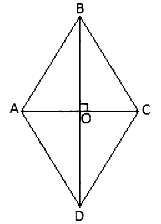
Diagonals of rhombus $\text{ABCD}$ intersect each other at point $O$.Prove that: $O A^2+O C^2=2 A D^2-\frac{B D^2}{2}$
Answer

Diagonals of the rhombus are perpendicular to each other.
In quadrilateral $\text{ABCD} , \angle AOD =\angle COD =90^{\circ}$.
So, $\triangle AOD$ and $\triangle COD$ are right-angled triangles.
In $\triangle A O D$ using Pythagoras theorem,
$A D^2=O A^2+O D^2$
$\Rightarrow O A^2=A D^2-O D^2\dots ....(i)$
In $\triangle COD$ using Pythagoras theorem,
$C D^2=O C^2+O D^2$
$\Rightarrow O C^2=C D^2-O D^2\dots....(ii)$
$ \text { LHS }=O A^2+O C^2$
$ =A D^2-O D^2+C D^2-O D^2 \ldots[$ From $(i)$ and $(ii)]$
$ =A D^2+C D^2-2 O D^2$
$ =A D^2+A D^2-2(\frac{B D}{2})^2 \ldots[A D=C D$ and  $O D=\frac{B D}{2}]$
$ =2 A D^2-\frac{(B D)^2}{2}$
$ =\text { RHS. }$
View full question & answer
Question 95 Marks
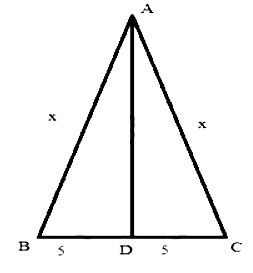
In $\triangle ABC, AB = AC = x, BC = 10 \ cm$ and the area of the triangle is $60 \sim cm^2$.Find $x$.
Answer
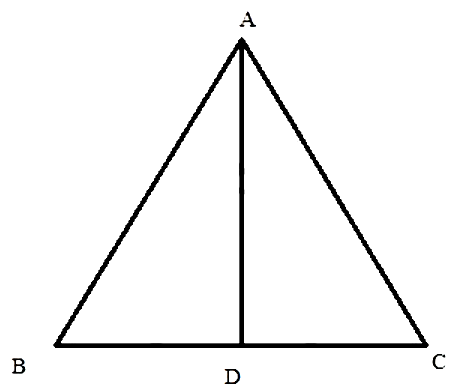
Here, the diagram will be,

We have Pythagoras theorem which states that in a right$-$angled triangle,
the square on the hypotenuse is equal to the sum of the squares on the remaining two sides.
Since $\text{ABC}$ is an isosceles triangle,
$\therefore$ perpendicular from vertex will cut the base in two equal segments.
First, we consider the $\triangle A B D$, and applying Pythagoras theorem we get,
$A B^2=A D^2+B D^2$
$A D^2=x^2-5^2$
$A D^2=x^2-25$
$AD =\sqrt{x^2-25}\dots .....(i)$
Now,
Area $=60$
$\frac{1}{2} \times 10 \times AD =60$
$\frac{1}{2} \times 10 \times \sqrt{x^2-25}=60$
$x=13$
Therefore, $x$ is $13 \ cm$.
View full question & answer
Question 105 Marks
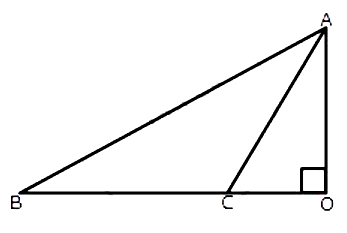
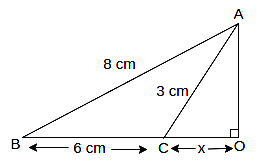
In $\triangle A B C$, given below, $A B=8 \ cm , B C=6 \ cm$ and $A C=3 \ cm$. Calculate the length of $O C$.
Answer
We have Pythagoras theorem which states that in a right$-$angled triangle,
the square on the hypotenuse is equal to the sum of the squares on the remaining two sides.

In $\triangle AOC _r$
$A C^2=A O^2+C O^2$
$(3)^2=A O^2+x^2$
$9= AO ^2+ x ^2$
$9-x^2=A O^2\dots ...(i)$
In $\triangle AOB _t$
$A B^2=A O^2+B O^2$
$(8)^2=A O^2+(6+x)^2$
$64= AO ^2+(6+x)^2$
$64-(6+x)^2=A O^2 \dots...(ii)$
From equation $(i)$ and $(ii)$
$9-x^2=64-(6+x)^2$
$9-x^2=64-\left(36+x^2+12 x\right) \ldots\left[(a+b)^2=a^2+2 a b+b^2\right]$
$ 9-x^2=64-36-x^2-12 x$
$ 9=28-12 x$
$ 12 x=28-9$
$ x=\frac{19}{12}$
$ x=1 \frac{7}{12}$
View full question & answer
Question 115 Marks
$AD$ is drawn perpendicular to base $BC$ of an equilateral $\triangle ABC$. Given $BC = 10 \ cm$, find the length of $AD$, correct to $1$ place of decimal.
Answer
Since $\text{ABC}$ is an equilateral triangle
$\therefore,$ all the sides of the triangle are of the same measure and
the perpendicular $AD$ will divide $BC$ into two equal parts.

Pythagoras theorem states that in a right$-$angled triangle,
​​​​​​​ the square on the hypotenuse is equal to the sum of the squares on the remaining two sides.
Here, we consider the $\triangle A B D$ and applying Pythagoras theorem we get,
$A B^2=A D^2+B D^2$
$AD ^2=10^2-5^2 \ldots \ldots .\left[\right.$ Given, $\left.BC =10 \ cm = AB , BD =\frac{1}{2} BC \right]$
$A D^2=100-25$
$A D^2=75$
$A D=8.7$
Therefore, the length of $A D$ is $8.7 \ cm$
 
View full question & answer
Question 125 Marks
In $\triangle ABC$,Find the sides of the triangle, if:
  1. $AB = ( x - 3 ) \ cm, BC = ( x + 4 ) \ cm$ and $AC = ( x + 6 ) \ cm$
  2. $AB = x \ cm, BC = ( 4x + 4 ) \ cm$ and $AC = ( 4x + 5) \ cm$
Answer

$(i)$ In right$-$angled $\triangle ABC$,
$A C^2=A B^2+B C^2$
$ \Rightarrow(x+6)^2=(x-3)^2+(x+4)^2$
$ \Rightarrow\left(x^2+12 x+36\right)=\left(x^2-6 x+9\right)+\left(x^2+8 x+16\right)$
$ \Rightarrow x^2-10 x-11=0$
$ \Rightarrow(x-11)(x+1)=0$
$\Rightarrow x=11 \quad$ or $ x=-1$
But length of the side of a triangle can not be negative.
$\Rightarrow x=11 \ cm$
$\therefore A B=(x-3)=(11-3)=8 \ cm$
$B C=(x+4)=(11+4)=15 \ cm$
$AC =( x +6)=(11+6)=17 \ cm$
$(ii)$ In right$-$angled $\triangle ABC$,
$A C^2=A B^2+B C^2$
$ \Rightarrow(4 x+5)^2=(x)^2+(4 x+4)^2$
$ \Rightarrow\left(16 x^2+40 x+25\right)=\left(x^2\right)+\left(16 x^2+32 x+16\right)$
$\Rightarrow x^2-8 x-9=0$
$\Rightarrow(x-9)(x+1)=0$
$\Rightarrow x=9$ or $x=-1$
But length of the side of a triangle can not be negative.
$\Rightarrow x=9 \ cm$
$\therefore A B=x=9 \ cm$
$B C=(4 x+4)=(36+4)=40 \ cm$
$A C=(4 x+5)=(36+5)=41 \ cm$
View full question & answer
Question 135 Marks
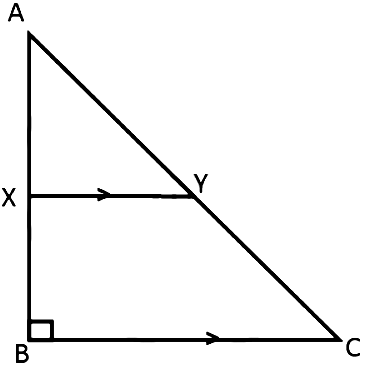
In the given figure, $\angle B=90^{\circ}, X Y \| B C, A B=12 cm , A Y=8 cm$ and $A X: X B=1: 2=A Y: Y C$.Find the lengths of $A C$ and $B C$.
Answer
Given that $A X: X B=1: 2=A Y: Y C$.
Let $x$ be the common multiple for which this proportion gets satisfied.
So, $A X=1 x$ and $X B=2 x$
$A X+X B=1 x+2 x=3 x$
$\Rightarrow A B=3 x \ldots . .(A-X-B)$
$\Rightarrow 12=3 x$
$\Rightarrow x=4$
$A X=1 x=4$ and $X B=2 x=2 \times 4=8$
Similarly,
$A Y=1 y$ and $Y C=2 y$
$ A Y=8 \ldots($given$)$
$ \Rightarrow 8=y$
$ \therefore Y C=2 y=2 \times 8=16$
$ \therefore A C=A Y+Y C$
$ A C=8+16$
$AC =24 \ cm$
$\triangle ABC$ is a right angled triangle$\dots. ...($Given$)$
$\therefore$ By Pythagoras Theorem, we get
$ \Rightarrow A B^2+B C^2=A C^2$
$ \Rightarrow B C^2=A C^2-A B^2$
$ \Rightarrow B C^2=(24)^2-(12)^2$
$ \Rightarrow B C^2=576-144$
$ \Rightarrow B C^2=432$
$ \Rightarrow B C=\sqrt{432}$
$ \Rightarrow B C=2 \times 2 \times 3 \sqrt{3}$
$ \Rightarrow B C= 1 2 \sqrt{ 3 } \sim c m $
View full question & answer
Question 145 Marks
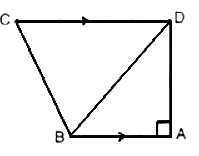
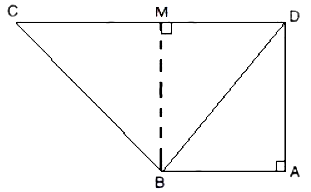
In the given figure, $A B \| C D, A B=7 \ cm , B D=25 \ cm$ and $C D=17 \ cm$;find the length of side $BC$.
Answer
Take $M$ to be the point on $C D$ such that $A B=D M$.
So $DM =7 \ cm$ and $MC =10 \ cm$
Join points $B$ and $M$ to form the line segment $BM$.
So $B M \| A D$ also $B M=A D$.

In right$-$angled $\triangle B A D$,
$B D^2=A D^2+B A^2$
$ (25)^2=A D^2+(7)^2$
$ A D^2=(25)^2-(7)^2$
$ A D^2=576$
$ A D=24$
In right$-$angled $\triangle C M B$,
$C B^2=C M^2+M B^2$
$C B^2=(10)^2+(24)^2\ldots[ MB = AD ]$
$ C B^2=100+576$
$ C B^2=676$
$ C B=26 \ cm $
View full question & answer
[5 marks sum] - MATHEMATICS STD 9 Questions - Vidyadip