Pythagoras Theorem [Proof and Simple Applications with Converse] — MATHEMATICS STD 9 — Question
ICSE BoardEnglish MediumSTD 9MATHEMATICSPythagoras Theorem [Proof and Simple Applications with Converse]4 Marks
Question
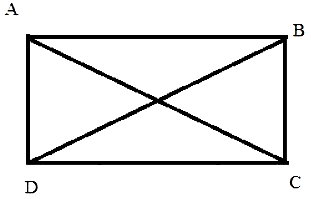
In a rectangle$\text{ABCD},$prove that : $AC^2+ BD^2= AB^2+ BC^2+ CD^2+ DA^2.$
✓
Answer
Pythagoras theorem states that in a right$-$angled triangle,
the square on the hypotenuse is equal to the sum of the squares on the remaining two sides.
Since, $\text{ABCD}$ is a rectangle angles $A, B, C$ and $D$ are $rt.$ angles.
First, we consider the $\triangle A C D$,
and applying Pythagoras theorem we get,
$AC ^2= DA ^2+ CD ^2 \dots....(i)$
Similarly, we get from $rt.$ angle $\triangle BDC$ we get,
$BD ^2= BC ^2+ CD ^2$
$=B C^2+A B^2\ldots .[$ In a rectangle, opposite sides are equal, $\therefore C D=AB ] \ldots (ii)$
Adding $(i)$ and $(ii)$
$A C^2+B D^2=A B^2+B C^2+C D^2+D A^2$
Hence proved.
Need a full question paper?
Generate a complete, print-ready paper with questions like this in minutes — across 16+ boards, with answer keys.