Questions

[4 marks sum]

🎯

Test yourself on this topic

23 questions · timed · auto-graded

Question 14 Marks
In a quadrilateral $\text{ABCD}, \angle B=90^{\circ}$ and $\angle D=90^{\circ}$.Prove that: $2 A C^2-A B^2=B C^2+C D^2+D A^2$
Answer
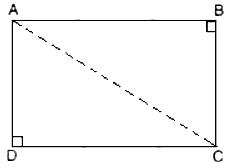
In quadrilateral $ABCD , \angle B =90^{\circ}$ and $\angle D =90^{\circ}$.
 So, $\triangle ABC$ and $\triangle ADC$ are right$-$angled triangles.
In $\triangle ABC$, using Pythagoras theorem,
$A C^2=A B^2+B C^2$
$\Rightarrow A B^2=A C^2-B C^2 \ldots...(i)$
In $\triangle A D C$, using Pythagoras theorem,
$A C^2=A D^2+D C^2 ...(ii)$
$LHS =2 AC ^2- AB ^2$
$=2 A C^2-\left(A C^2-B C^2\right) .....[$From$(i) ]$
$=2 A C^2-A C^2+B C^2$
$= AC ^2+ BC ^2$
$ = AD ^2+ DC ^2+ BC ^2 \ldots .[$From$(ii)]$
$ =\text{RHS}$
View full question & answer
Question 24 Marks
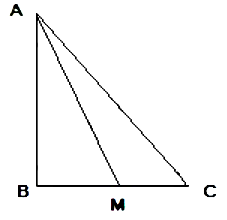
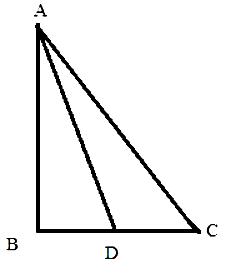
In $\triangle ABC,\angle B = 90^o$ and $D$ is the mid$-$point of $BC.$Prove that: $AC^2= AD^2+ 3CD^2.$
Answer

Pythagoras theorem states that in a right$-$angled triangle,
the square on the hypotenuse is equal to the sum of the squares on the remaining two sides.
In $\triangle ABC C_t \angle B =90^{\circ}$ and $D$ is the mid$-$point of $BC$.
Join $AD$.
Therefore, $BD = DC$
First, we consider the $\triangle A D B$,
 and applying Pythagoras theorem we get,
$A D^2=A B^2+B D^2$
$A B^2=A D^2-B D^2\ldots...(i)$
Similarly, we get from $rt.$ angle triangles $ABC$ we get,
$A C^2=A B^2+B C^2$
$A B^2=A C^2-B C^2 \dots.....(ii)$
 From $(i)$ and $(ii)$
$A C^2-B C^2=A D^2-B D^2$
$A C^2=A D^2-B D^2+B C^2$
$A C^2=A D^2-C D^2+4 C D^2 \quad \ldots .\left[B D=C D=\frac{1}{2} B C\right]$
$A C^2=A D^2+3 C D^2$
Hence proved.
View full question & answer
Question 34 Marks
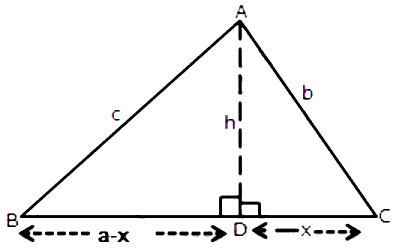
In the figure, given below, $A D \perp B C$.Prove that: $c^2=a^2+b^2-2 a x$.
Answer
Pythagoras theorem states that in a right$-$angled triangle,
the square on the hypotenuse is equal to the sum of the squares on the remaining two sides.
First, we consider the $\triangle ABD$ and applying Pythagoras theorem we get,
$AB^2 = AD^2 + BD^2$
$c^2 = h^2 + ( a - x )^2$
$h^2 = c^2 - ( a - x )^2 ......(i)$
First, we consider the $\triangle ACD$ and applying Pythagoras theorem we get,
$AC^2 = AD^2 + CD^2$
$b^2 = h^2 + x^2$
$h^2 = b^2 - x^2 ......(ii)$
From $(i)$ and $(ii)$ we get,
$c^2 - ( a - x )^2 = b^2 - x^2$
$c^2 - a^2- x^2 + 2ax = b^2 - x^2$
$c^2 = a^2 + b^2 - 2ax$
Hence Proved.
View full question & answer
Question 44 Marks
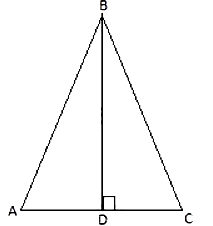
In $\triangle ABC, AB = AC$ and $BD$ is perpendicular to $AC.$Prove that: $BD^2- CD^2= 2CD \times AD.$
Answer

In right-angled $\triangle ADB$,
$A B^2=A D^2+B D^2$
$\Rightarrow A D^2=A B^2-B D^2 .....(i)$
$ A C=A D+D C$
$ \Rightarrow A C^2=(A D+D C)^2$
$ \Rightarrow A C^2=A D^2+D C^2+2 A D \times D C$
$ \Rightarrow AC ^2= AB ^2- BD ^2+ DC ^2+2 AD \times DC \ldots[$ From $(i)]$
$ \Rightarrow A C^2=A C^2-B D^2+D C^2+2 A D \times D C \ldots[A B=A C]$
$ \Rightarrow BD ^2- DC ^2=2 AD \times DC.$
 
View full question & answer
Question 54 Marks
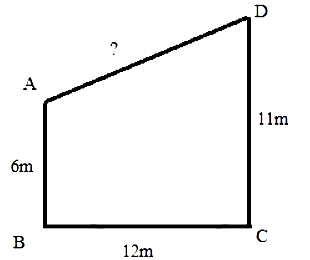
Two poles of heights $6\ m$ and $11\ m$ stand vertically on a plane ground. If the distance between their feet is $12\ m;$find the distance between their tips.
Answer
The diagram of the given problem is given below,

We have Pythagoras theorem which states that in a right$-$angled triangle,
the square on the hypotenuse is equal to the sum of the squares on the remaining two sides.
Here, $11-6=5 \ m \dots... ($ Since $DC$ is perpendicular to $BC)$
base $=12 \ cm$
Applying Pythagoras theorem we get, hypotenuse ${ }^2=5^2+12^2$
$h^2=25+144$
$ h^2=169$
$ h=13$
Therefore, the distance between the tips will be $13\ m$.
View full question & answer
Question 64 Marks
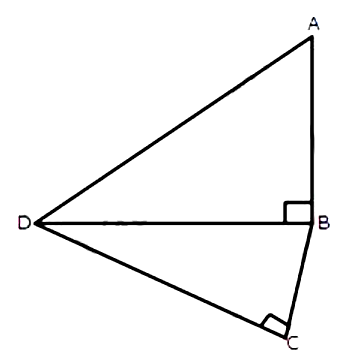
The given figure shows a quadrilateral $\text{ABCD}$ in which $A D=13 \ cm$, $D C=12 \ cm , B C=3 \ cm$ and $\angle A B D=\angle B C D=90^{\circ}$. Calculate the length of $A B$.
Answer
Pythagoras theorem states that in a right$-$angled triangle, the square on the hypotenuse is equal to the sum of the squares on the remaining two sides.
First, we consider the $\triangle BDC$ and applying Pythagoras theorem we get,
$DB^2 = DC^2 + BC^2$
$DB^2 = 12^2 + 3^2$
$DB^2 = 144 + 9$
$DB^2 = 153$
Now, we consider the $\triangle ABD$ and applying Pythagoras theorem we get,
$DA^2 = DB^2 + BA^2$
$13^2 = 153 + BA^2$
$BA^2 = 169 - 153$
$BA = 4$
The length of $AB$ is $4 \ cm.$
View full question & answer
Question 74 Marks
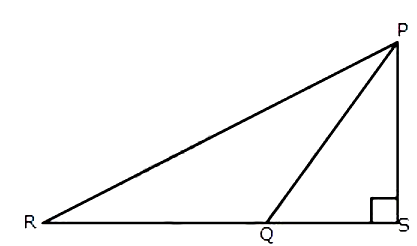
In the figure: $\angle PSQ =90^{\circ}, PQ =10 \ cm , QS =6 \ cm$ and $RQ =9 \ cm$. Calculate the length of $PR.$
Answer
Pythagoras theorem states that in a right$-$angled triangle,
the square on the hypotenuse is equal to the sum of the squares on the remaining two sides.
First, we consider the $\triangle PQS$ and applying Pythagoras theorem we get,
$PQ^2 = PS^2 + QS^2$
$10^2= PS^2 + 6^2$
$PS^2 = 100 - 36$
$PR = 8$
Now, we consider the $\triangle PRS$ and applying Pythagoras theorem we get,
$PR^2 = RS^2 + PS^2$
$PR^2 = 15^2 + 8^2$
$PR = 17$
The length of $\text{PR}\ 17 \ cm.$
View full question & answer
Question 84 Marks
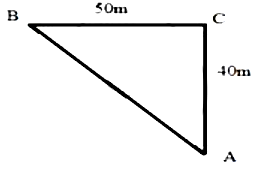
A man goes $40\ m$ due north and then $50\ m$ due west. Find his distance from the starting point.
Answer
Here, we need to measure the distance $A B$ as shown in the figure below,

Pythagoras theorem states that in a right$-$angled triangle,
the square on the hypotenuse is equal to the sum of the squares on the remaining two sides.
Therefore, in this case
$A B^2=B C^2+C A^2$
$ A B^2=50^2+40^2$
$ A B^2=2500+1600$
$ A B^2=4100$
$ A B=64.03$
Therefore the required distance is $64.03\ m$.
View full question & answer
Question 94 Marks
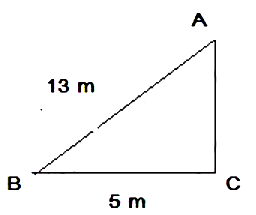
A ladder $13\ m$ long rests against a vertical wall. If the foot of the ladder is $5\ m$ from the foot of the wall, find the distance of the other end of the ladder from the ground.
Answer
The pictorial representation of the given problem is given below,

Pythagoras theorem states that in a right$-$angled triangle,
the square on the hypotenuse is equal to the sum of the squares on the remaining two sides.
Here, $A B$ is the hypotenuse.
Therefore applying the Pythagoras theorem we get,
$ A B^2=B C^2+C A^2$
$ 13^2=5^2+C A^2$
$ C A^2=13^2-5^2$
$ C A^2=144$
$ C A=12\ m$
Therefore, the distance of the other end of the ladder from the ground is $12\ m$.
View full question & answer
Question 104 Marks
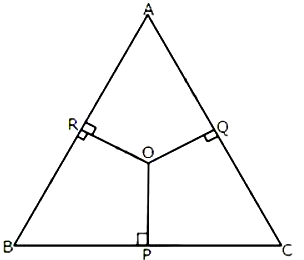
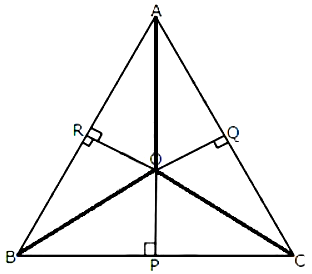
In the following figure, $O P, O Q$ and $O R$ are drawn perpendiculars to the sides $B C, C A$ and $A B$ respectively of $\triangle A B C$.Prove that: $AR ^2+ BP ^2+ CQ ^2= AQ ^2+ CP ^2+ BR ^2$
Answer
Here, we first need to join $OA , OB$, and $OC$ after which the figure becomes as follows,

Pythagoras theorem states that in a right$-$angled triangle,
the square on the hypotenuse is equal to the sum of the squares on the remaining two sides.
First, we consider the $\triangle A R O$ and applying Pythagoras theorem we get,
$A Q^2=A R^2+O R^2$
$A R^2=A O^2-O R^2 \dots....(i)$
Similarly, from triangles, $\text{BPO} , \text{COQ} , \text{AOQ}, \text{CPO}$, and $\text{BRO}$ we get the following results,
$BP ^2= BO ^2-O P^2 \dots....(ii)$
$C Q^2=O C^2-O Q^2\dots ....(iii)$
$AQ ^2= AO ^2- OQ ^2\dots ....(iv)$
$C P^2=O C^2-O P^2\dots ....(v)$
$BR ^2=O B^2-O R^2\dots ....(vi)$
Adding $(i), (ii)$ and $(iii),$ we get
$A R^2+B P^2+C Q^2=A O^2-O R^2+B O^2-O P^2+O C^2-O Q^2\dots....(vii)$
Adding $(iv), (v)$ and $(vi),$ we get,
$A Q^2+C P^2+B R^2=A O^2-O R^2+B O^2-O P^2+O C^2-O Q^2 \dots....(viiii)$
From $(vii)$ and $(viii)$, we get,
$A R^2+B^2+C Q^2=A Q^2+C P^2+B R^2$
Hence proved.
 
View full question & answer
Question 114 Marks
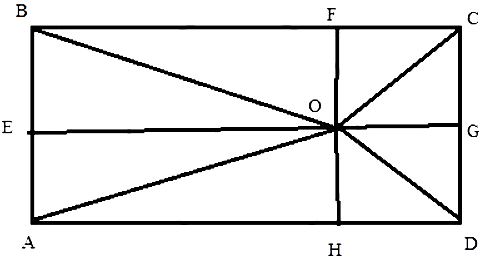
$O$ is any point inside a rectangle $\text{ABCD}$.Prove that: $OB^2+ OD^2= OC^2+ OA^2$.
Answer

Draw rectangle $\text{ABCD}$ with arbitrary point $O$ within it,
and then draw lines $O A, O B, O C, O D$.
Then draw lines from point $O$ perpendicular to the sides: $OE , OF , OG , OH$.
Pythagoras theorem states that in a right$-$angled triangle,
the square on the hypotenuse is equal to the sum of the squares on the remaining two sides.
Using Pythagorean theorem we have from the above diagram:
$ O A^2=A H^2+O H^2=A H^2+A^2$
$ O C^2=C G^2+O G^2= EB ^2+ HD ^2$
$ O B^2=E O^2+ BE ^2=A H^2+ BE ^2$
$ O D^2= HD ^2+ OH ^2= HD ^2+ AE ^2$
Adding these equalities we get:
$O A^2+O C^2=A H^2+H D^2+A E^2+E B^2$
$ O B^2+O D^2=A H^2+H D^2+A E^2+E B^2$
From which we prove that for any point within the rectangle there is the relation
$O A^2+O C^2=O B^2+O D^2$
Hence Proved.
View full question & answer
Question 124 Marks
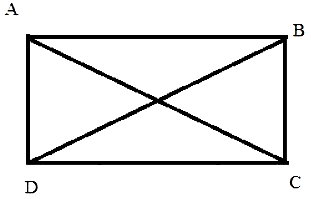
In a rectangle $\text{ABCD},$prove that : $AC^2+ BD^2= AB^2+ BC^2+ CD^2+ DA^2.$
Answer

Pythagoras theorem states that in a right$-$angled triangle,
the square on the hypotenuse is equal to the sum of the squares on the remaining two sides.
Since, $\text{ABCD}$ is a rectangle angles $A, B, C$ and $D$ are $rt.$ angles.
First, we consider the $\triangle A C D$,
and applying Pythagoras theorem we get,
$AC ^2= DA ^2+ CD ^2 \dots....(i)$
Similarly, we get from $rt.$ angle $\triangle BDC$ we get,
$BD ^2= BC ^2+ CD ^2$
$=B C^2+A B^2\ldots .[$ In a rectangle, opposite sides are equal, $\therefore C D=AB ] \ldots (ii)$
Adding $(i)$ and $(ii)$
$A C^2+B D^2=A B^2+B C^2+C D^2+D A^2$
Hence proved.
View full question & answer
Question 134 Marks
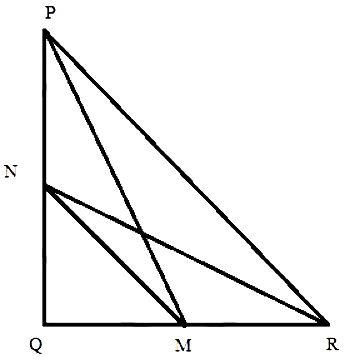
$M$ and $N$ are the mid$-$points of the sides $QR$ and $PQ$ respectively of a $\text{PQR},$ right$-$angled at $Q$.Prove that :$(i) \ PM^2+ RN^2= 5 MN^2(ii) \ 4 PM^2= 4 PQ^2+ QR^2$$(iii)\ 4 RN^2= PQ^2+ 4 QR^2(iv) \ 4 (PM^2+ RN^2) = 5 PR^2$
Answer

We draw$, PM, MN, NR$
Pythagoras theorem states that in a right$-$angled triangle,
the square on the hypotenuse is equal to the sum of the squares on the remaining two sides.
Since $M$ and $N$ are the mid$-$points of the sides $Q R$ and $P Q$ respectively,
therefore, $PN = NQ , QM = RM$
$(i)$ First, we consider the $\triangle PQM$,
and applying Pythagoras theorem we get,
$ PM ^2= PQ ^2+ MQ ^2$
$ =( PN + NQ )^2+ MQ ^2$
$ = PN + NQ ^2+2 PN \cdot NQ + MQ ^2$
$= MN ^2+ PN ^2+2 PN . NQ \ldots\left[\right.$ From $\left., \Delta MNQ , MN ^2= NQ ^2+ MQ ^2\right] \ldots \ldots .. (i)$
Now, we consider the $\triangle RNQ$,
and applying Pythagoras theorem we get,
$ R^2=N Q^2+R Q^2$
$ =N Q^2+(Q M+R M)^2$
$ =N Q^2+Q^2+R M^2+2 Q M \cdot R M$
$= MN ^2+ RM ^2+2 QM \cdot RM \dots.......(ii)$
Adding $(i)$ and $(ii)$ we get,
$ PM ^2+ RN ^2= MN ^2+ PN ^2+2 PN \cdot NQ + MN ^2+ RM ^2+2 QM \cdot RM$
$ PM ^2+ RN ^2=2 MN ^2+ PN ^2+ RM ^2+2 PN \cdot NQ +2 QM \cdot RM$
$ PM ^2+ RN ^2=2 MN ^2+ NQ ^2+ QM ^2+2\left( QN ^2\right)+2\left( QM ^2\right)$
$ PM ^2+ RN ^2=2 MN ^2+ MN ^2+2 MN ^2$
$ PM ^2+ RN ^2=5 MN ^2$
Hence Proved.
$(ii)$ We consider the $\triangle PQM$,
and applying Pythagoras theorem we get,
$PM ^2= PQ ^2+ MQ ^2$
$4 PM ^2=4 PQ ^2+4 MQ ^2\dots ... [$ Multiply both sides by $4]$
$4 PM ^2=4 PQ ^2+4 \cdot\left(\frac{1}{2} QR \right)^2 \ldots\left[ MQ =\frac{1}{2} QR \right]$
$ 4 PM ^2=4 PQ ^2+4 PQ +4 \cdot \frac{1}{4} QR ^2$
$ 4 PM ^2=4 PQ ^2+ QR ^2$
Hence Proved.
$(iii)$ We consider the $\triangle RQN$,
 and applying Pythagoras theorem we get,
$R N^2=N Q^2+R Q^2$
$4 RN ^2=4 NQ ^2+4 QR ^2 \ldots[$ Multiplying both sides by $4]$
$4 RN ^2=4 QR ^2+4 \cdot(1 / 2 PQ )^2 \ldots\left[ NQ =\frac{1}{2} PQ \right]$
$ 4 RN ^2=4 QR ^2+4 \cdot \frac{1}{4} PQ ^2$
$ 4 RN ^2 = PQ ^2+4 QR ^2$
Hence Proved.
$(iv)$ First, we consider the $\triangle PQM$, and applying Pythagoras theorem we get,
$ PM ^2= PQ ^2+ MQ ^2$
$ =( PN + NQ )^2+ MQ ^2$
$ = PN ^2+ NQ ^2+2 PN \cdot NQ + MQ ^2$
$= MN ^2+ PN ^2+2 PN . NQ \ldots[$ From, $\Delta MNQ _1= MN ^2= NQ ^2+ MQ ^2] \ldots \ldots(i)$
Now, we consider the $\triangle RNQ$,
and applying Pythagoras theorem we get,
$RN ^2+ NQ ^2+ RQ ^2$
$=N Q^2+(Q M+R M)^2$
$= NQ ^2+ QM ^2+ RM ^2+2 QM \cdot RM$
$= MN ^2+ RM ^2+2 QM \cdot RM \ldots \ldots .. (ii)$
Adding $(i)$ and $(ii)$ we get,
$PM ^2+ RN ^2= MN ^2+ PN ^2+2 PN \cdot NQ + MN ^2+ RM ^2+2 QM \cdot RM$
$PM ^2+ RN ^2=2 MN ^2+ PN ^2+ RM ^2+2 PN \cdot NQ +2 QM \cdot RM$
$PM ^2+ RN ^2=2 MN ^2+ NQ ^2+ QM ^2+2\left( QN ^2\right)+2\left( QM ^2\right)$
$PM ^2+ RN ^2=2 MN ^2+ MN ^2+2 MN ^2$
$P M^2+ RN ^2=5 MN ^2$
$4\left( PM ^2+ RN ^2\right)=4 \cdot 5 \cdot\left( NQ ^2+ MQ ^2\right)$
$ 4\left( PM ^2+ RN ^2\right)=4.5$
$ {\left[\left(\frac{1}{2} PQ \right)^2+\left(\frac{1}{2} RQ \right)^2\right] \ldots\left[\because NQ =\frac{1}{2} PQ , MQ =\frac{1}{2} QR \right]}$
$4\left(P M^2+R N^2\right)=5 P R^2$
Hence Proved.
View full question & answer
Question 144 Marks
$\text{ABC}$ is a triangle, right$-$angled at $B. M$ is a point on $BC$.Prove that: $AM^2+ BC^2= AC^2+ BM^2$.
Answer
The pictorial form of the given problem is as follows,

Pythagoras theorem states that in a right$-$angled triangle,
the square on the hypotenuse is equal to the sum of the squares on the remaining two sides.
First, we consider the $\triangle A B M$ and applying Pythagoras theorem we get,
$AM ^2= AB + BM ^2$
$A B^2=A M^2-B M^2\dots ......(i)$
Now, we consider the $\triangle A B C$ and applying Pythagoras theorem we get,
$A C^2=A B^2+B C^2$
$A B^2=A C^2-B C^2\dots ......(ii)$
From $(i)$ and $(ii)$ we get,
$A M^2 \cdot B M^2=A C^2-B C^2$
$ A M^2+B C^2=A C^2+B M^2$
Hence Proved
View full question & answer
Question 154 Marks
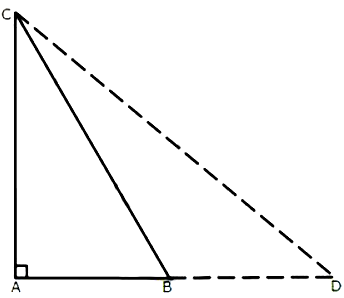
In $\triangle A B C$, $\angle A=90^{\circ}, C A=A B$ and $D$ is the point on $A B$ produced.Prove that $D C^2-B D^2=2 A B \cdot A D$.
Answer
Pythagoras theorem states that in a right$-$angled triangle,
the square on the hypotenuse is equal to the sum of the squares on the remaining two sides.
We consider the $rt.$ angled $\triangle ACD$ and applying Pythagoras theorem we get,
$C D^2=A C^2+A D^2$
$C D^2=A C^2+(A B+B D)^2 \ldots .[\because A D=A B+B D]$
$C D^2=A C^2+A B^2+B D^2+2 A B \cdot B D\ldots (i)$
Similarly, in $\triangle ABC$,
$B C^2=A C^2+A B^2$
$B C^2=2 A B^2\ldots[ AB = AC ]$
$AB ^2=\frac{1}{2} BC ^2 \dots...(ii)$
Putting, $AB^2$ from $(ii)$ in $(i),$ We get,
$C D^2=A C^2+\frac{1}{2} B C^2+B D^2+2 A B \cdot B D$
$ C D^2-B D^2=A B^2+A B^2+2 A B \cdot(A D-A B)$
$ C D^2-B D^2=A B^2+A B^2+2 A B \cdot A D-2 A B^2$
$ C D^2-B D^2=2 A B \cdot A D$
$ D C^2-B D^2=2 A B \cdot A D$
Hence Proved.
View full question & answer
Question 164 Marks
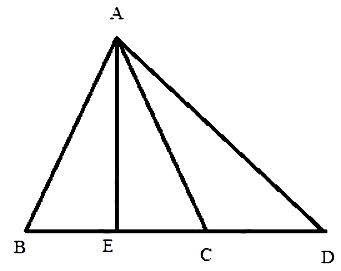
In an isosceles $\triangle ABC; AB = AC$ and $D$ is the point on $BC$ produced.Prove that: $AD^2= AC^2+ BD.CD$.
Answer

In an isosceles triangle $A B C ; A B=A C$ and $D$ is the point on $B C$ produced.
Construct $AE$ perpendicular $BC$.
Pythagoras theorem states that in a right$-$angled triangle,
the square on the hypotenuse is equal to the sum of the squares on the remaining two sides.
We consider the $rt.$ angled $\triangle AED$ and applying Pythagoras theorem we get,
$ A D^2=A E^2+E D^2$
$ A D^2=A E^2+(E C+C D)^2 \ldots . .(i)\ [\because E D=E C+C D]$
Similarly, in $\triangle A E C$,
$A C^2=A E^2+E C^2$
$AE ^2= AC ^2- EC ^2 \dots....(ii)$
Putting $A E^2=A C^2-E C^2$ in $(i),$ We get,
$A D^2 =A C^2-E C^2+(E C+C D)^2$
$ =A C^2+C D(C D+2 E C)$
$A D^2=A C^2+B D \cdot C D\ldots \ldots[\because 2 E C+C D=B D]$
Hence proved.
View full question & answer
Question 174 Marks
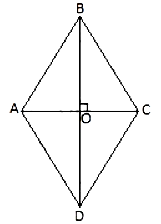
Diagonals of rhombus $\text{ABCD}$ intersect each other at point $O$.Prove that: $O A^2+O C^2=2 A D^2-\frac{B D^2}{2}$
Answer

Diagonals of the rhombus are perpendicular to each other.
In quadrilateral $\text{ABCD} , \angle AOD =\angle COD =90^{\circ}$.
So, $\triangle AOD$ and $\triangle COD$ are right$-$angled triangles.
In $\triangle A O D$ using Pythagoras theorem,
$A D^2=O A^2+O D^2$
$\Rightarrow O A^2=A D^2-O D^2 \dots....(i)$
In $\triangle COD$ using Pythagoras theorem,
$C D^2=O C^2+O D^2$
$\Rightarrow O C^2=C D^2-O D^2 \dots....(ii)$
$ \text { LHS }=O A^2+O C^2$
$ =A D^2-O D^2+C D^2-O D^2 \ldots[$From $(i)$ and $(ii)]$
$ =A D^2+C D^2-2 O D^2$
$ =A D^2+A D^2-2\left(\frac{B D}{2}\right)^2 \ldots[A D=C D$ and $O D=\frac{B D}{2}]$
$ =2 A D^2-\frac{(B D)^2}{2}$
$ =\text { RHS. }$
View full question & answer
Question 184 Marks
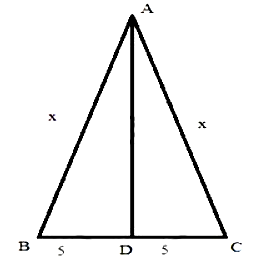
In $\triangle ABC, AB = AC = x, BC = 10\ cm$ and the area of the triangle is $60 \ cm^2$.Find $x.$
Answer
Here, the diagram will be,

We have Pythagoras theorem which states that in a right$-$angled triangle,
the square on the hypotenuse is equal to the sum of the squares on the remaining two sides.
Since $\text{ABC}$ is an isosceles triangle,
therefore perpendicular from vertex will cut the base in two equal segments.
First, we consider the $\triangle A B D$, and applying Pythagoras theorem we get,
$ A B^2=A D^2+B D^2$
$ A D^2=x^2-5^2$
$ A D^2=x^2-25$
$AD =\sqrt{x^2-25} \dots.....(i)$
Now,
Area $=60$
$ \frac{1}{2} \times 10 \times AD =60$
$ \frac{1}{2} \times 10 \times \sqrt{x^2-25}=60$
$ x=13$
Therefore, $x$ is $13 \ cm$.
View full question & answer
Question 194 Marks
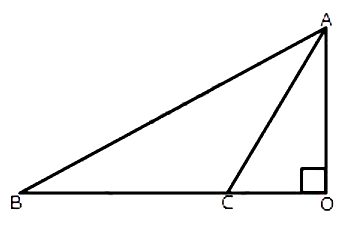
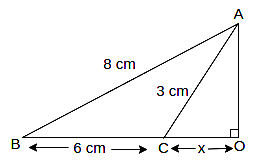
In $\triangle A B C$, given below, $A B=8 \ cm , B C=6 \ cm$ and $A C=3 \ cm$. Calculate the length of $O C$.
Answer
We have Pythagoras theorem which states that in a right$-$angled triangle,
the square on the hypotenuse is equal to the sum of the squares on the remaining two sides.

In $\triangle AOC _r$
$A C^2=A O^2+C O^2$
$(3)^2=A O^2+x^2$
$9= AO ^2+ x ^2$
$9-x^2=A O^2 \dots...(i)$
In $\triangle AOB _t$
$A B^2=A O^2+B O^2$
$(8)^2=A O^2+(6+x)^2$
$64= AO ^2+(6+x)^2$
$64-(6+x)^2=A O^2\dots ...(ii)$
From equation$ (i)$ and $(ii)$
$9-x^2=64-(6+x)^2$
$9-x^2=64-\left(36+x^2+12 x\right) \ldots\left[(a+b)^2=a^2+2 a b+b^2\right]$
$ 9-x^2=64-36-x^2-12 x$
$ 9=28-12 x$
$ 12 x=28-9$
$ x=\frac{19}{12}$
$ x=1 \frac{7}{12}$
View full question & answer
Question 204 Marks
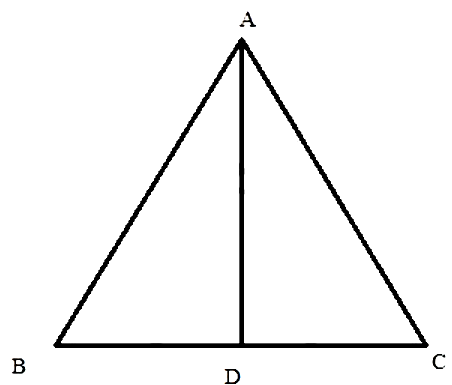
$AD$ is drawn perpendicular to base $BC$ of an equilateral $\triangle ABC.$ Given $BC = 10 \ cm,$ find the length of $AD,$ correct to $1$ place of decimal.
Answer
Since $\text{ABC}$ is an equilateral triangle therefore, all the sides of the triangle are of the same measure and the perpendicular $AD$ will divide $BC$ into two equal parts.

Pythagoras theorem states that in a right$-$angled triangle,
the square on the hypotenuse is equal to the sum of the squares on the remaining two sides.
Here, we consider the $\triangle A B D$ and applying Pythagoras theorem we get,
$A B^2=A D^2+B D^2$
$AD ^2=10^2-5^2 \ldots \ldots .\left[\right.$ Given, $\left.BC =10 \ cm = AB , BD =\frac{1}{2} BC \right]$
$A D^2=100-25$
$A D^2=75$
$A D=8.7$
Therefore, the length of $A D$ is $8.7 \ cm$
 
View full question & answer
Question 214 Marks
In $\triangle ABC,$ Find the sides of the triangle, if:
  1. $AB = ( x - 3 ) \ cm, BC = ( x + 4 ) \ cm$ and $AC = ( x + 6 ) \ cm$
  2. $AB = x \ cm, BC = ( 4x + 4 ) \ cm$ and $AC = ( 4x + 5) \ cm$
Answer

$(i)$ In right$-$angled $\triangle ABC$,
$A C^2=A B^2+B C^2$
$ \Rightarrow(x+6)^2=(x-3)^2+(x+4)^2$
$ \Rightarrow\left(x^2+12 x+36\right)=\left(x^2-6 x+9\right)+\left(x^2+8 x+16\right)$
$ \Rightarrow x^2-10 x-11=0$
$ \Rightarrow(x-11)(x+1)=0$
$\Rightarrow x=11 \quad$ or $ x=-1$
But length of the side of a triangle can not be negative.
$\Rightarrow x=11 \ cm$
$\therefore A B=(x-3)=(11-3)=8 \ cm$
$B C=(x+4)=(11+4)=15 \ cm$
$AC =( x +6)=(11+6)=17 \ cm$
$(ii)$ In right$-$angled $\triangle ABC$,
$A C^2=A B^2+B C^2$
$ \Rightarrow(4 x+5)^2=(x)^2+(4 x+4)^2$
$ \Rightarrow\left(16 x^2+40 x+25\right)=\left(x^2\right)+\left(16 x^2+32 x+16\right)$
$\Rightarrow x^2-8 x-9=0$
$\Rightarrow(x-9)(x+1)=0$
$\Rightarrow x=9$ or $x=-1$
But length of the side of a triangle can not be negative.
$\Rightarrow x=9 \ cm$
$\therefore A B=x=9 \ cm$
$B C=(4 x+4)=(36+4)=40 \ cm$
$A C=(4 x+5)=(36+5)=41 \ cm$
View full question & answer
Question 224 Marks
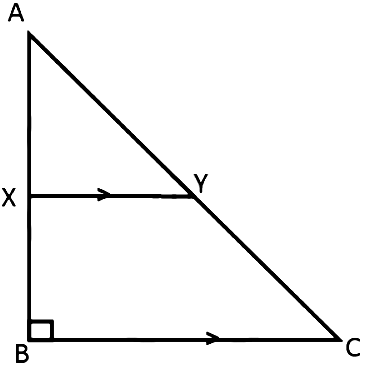
In the given figure, $\angle B=90^{\circ}, X Y\| B C, A B=12 \ cm , A Y=8 \ cm$ and $A X: X B=1: 2=A Y: Y C$.Find the lengths of $A C$ and $B C$.
Answer
Given that $A X: X B=1: 2=A Y: Y C$.
Let $x$ be the common multiple for which this proportion gets satisfied.
So, $A X=1 x$ and $X B=2 x$
$A X+X B=1 x+2 x=3 x$
$\Rightarrow A B=3 x \ldots . .(A-X-B)$
$\Rightarrow 12=3 x$
$\Rightarrow x=4$
$A X=1 x=4$ and $X B=2 x=2 \times 4=8$
Similarly,
$A Y=1 y$ and $Y C=2 y$
$ A Y=8 \ldots ($given$)$
$ \Rightarrow 8=y$
$ \therefore Y C=2 y=2 \times 8=16$
$ \therefore A C=A Y+Y C$
$ A C=8+16$
$AC =24 \ cm$
$\triangle ABC$ is a right angled triangle$\dots. ...($Given$)$
$\therefore$ By Pythagoras Theorem, we get
$ \Rightarrow A B^2+B C^2=A C^2$
$ \Rightarrow B C^2=A C^2-A B^2$
$ \Rightarrow B C^2=(24)^2-(12)^2$
$ \Rightarrow B C^2=576-144$
$ \Rightarrow B C^2=432$
$ \Rightarrow B C=\sqrt{432}$
$ \Rightarrow B C=2 \times 2 \times 3 \sqrt{3}$
$ \Rightarrow B C= 1 2 \sqrt{ 3 } \sim c m $
View full question & answer
Question 234 Marks
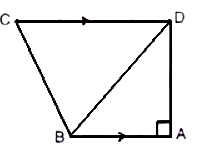
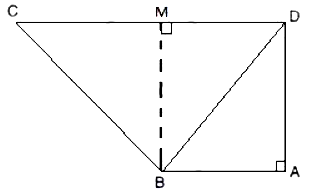
In the given figure, $A B \| C D, A B=7 \ cm , B D=25 \ cm$ and $C D=17 \ cm$;find the length of side $BC$.
Answer
Take $M$ to be the point on $C D$ such that $A B=D M$.
So $DM =7 \ cm$ and $MC =10 \ cm$
Join points $B$ and $M$ to form the line segment $BM$.
So $B M \| A D$ also $B M=A D$.

In right$-$angled $\triangle B A D$,
$B D^2=A D^2+B A^2$
$ (25)^2=A D^2+(7)^2$
$ A D^2=(25)^2-(7)^2$
$ A D^2=576$
$ A D=24$
In right$-$angled $\triangle C M B$,
$C B^2=C M^2+M B^2$
$C B^2=(10)^2+(24)^2$
$\ldots[ MB = AD ]$
$ C B^2=100+576$
$ C B^2=676$
$ C B=26 \ cm $
View full question & answer
[4 marks sum] - MATHEMATICS STD 9 Questions - Vidyadip