MCQ
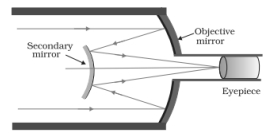
In a reflecting telescope, a secondary mirror is used to:
  • A
    reduce the problem of mechanical support
  • B
    remove spherical aberration
  • C
    make chromatic aberration zero
  • move the eyepiece outside the telescopic tube
Answer

Correct option: D.
move the eyepiece outside the telescopic tube
d
It has advantage of a large focal length in a short telescope

Need a full question paper?

Generate a complete, print-ready paper with questions like this in minutes — across 16+ boards, with answer keys.
Start Generating Free

Similar questions

Which of the following circuit provides full wave rectification of an $ac$ input ?
Two conductors are made of the same material and have the same length. Conductor $A$ is a solid wire of diameter $1.0\, mm$. Conductor $B$ is a hollow tube of outside diameter $2.0\, mm$ and inside diameter $1.0\, mm$. The resistance ratio $R_A/R_B$ will be
Two particles each of mass $m$ and charge $q$ are attached to the two ends of a light rigid rod of length $2R$. The rod is rotated at constant angular speed about a perpendicular axis passing through its centre. The ratio of the magnitudes of the magnetic moment of the system and its angular momentum about the centre of the rod is
Two lenses of power $-15\ D$ and $+5\ D$ are in contact with each other. The focal length of the combination is.......$cm$
Identify the operation performed by the circuit given below
Four wires $AB,\,\,BC,\,\,CD,\,\,DA$ of resistance $4\, \Omega$ each and a fifth wire $BD$ of resistance $8\, \Omega$ are joined to form a rectangle $ABCD$ of which $BD$ is a diagonal. The effective resistance between the points $A$ and $B$ is
The unit of dipole moment is:
Electric field intensity at a point in between two parallel sheets with like charges of same surface charge densities (σ) is
One can define an alpha-volt $(\alpha-V)$ to be the energy acquired by an $\alpha$-particle when it is accelerated by a potential of $1 \,V$. For this problem, you may take a proton to be $2000$ times heavier than an electron. Then,
Select the correct statements. Coulomb’s law correctly describes the electric force that:
i. binds the electrons of an atom to its nucleus.
ii. binds the protons and neutrons in the nucleus of an atom.
iii. binds atoms together to form molecules.